The GLAPOR obelisk

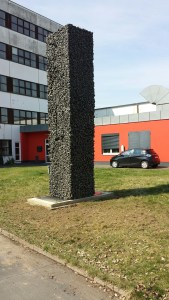
logo_smallThe old Egyptians invented the obelisk and were also producing the first glass. GLAPOR combined both and installed the first foamed glass gravel obelisk.

20170405_122551_resizedFoamed glass gravel is most of time used to fill a dwell (floor insulation) or to make a hill (garden landscape). In these cases, the gravel is installed and vibrated to a 30% more compact system. But it is also posibble to mix the gravel with a special adhesive, which allows to form a certain shape.

GLAPOR has chosen for an obelisk, which is also demonstrating that only the sky is the limit for cellular glass. The Egyptians have put the obelisk at the entrance of a temple. In this case, the obelisk guards the entrance of white and blue collars to show the equal importance of both in the succesful story of GLAPOR.

images

Prefabricated building with cellular glass

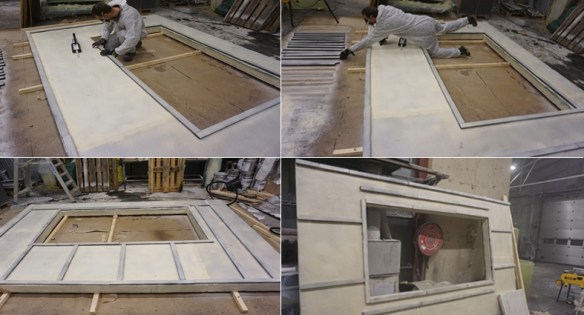
logo_smallPrefabricated building had never an image of durability but this could change now very fast. In a previous blog, we mentionned already the C-element, a system which uses large GLAPOR cellular glass boards. Today, theory became practice.

logoIndeed, on their website, they show now how this prefabrication is done. They started with 80 x 120 cm GLAPOR boards but later on, they were using 2.4 x 1.5m GLAPOR boards. Also the first (small) prefabricated building is shown. I copied a few pictures from the website showing prefabrication and installation.

design-img9.jpg

design-img11

In the next blog, we will discuss the patent, which is protecting this invention. This invention will change the buidling world a lot and this is only the beginning.


Acoustic absorption with open cell foam glass

logo_smallWe found a paper from 2011 about waste glass foaming with CaCO3.

The porous glass ‘foam glass’ is considered as the new glass products fulfill certain requirements in the building industry in particular (thermal and acoustic insulation). The production of foam glass based waste glass plays an important role in environmental protection and also gains in energy. As part of present work, we seek to improve the properties of glass to obtain a building material lighter with excellent insulation properties. The properties of foam glass depend on the porosity and morphology. The present work devoted to analyze the microstructure of the glass produced by scanning electron microscopy and optical microscopy to be more precise on the size and shape of pores constitute this material.

Algeria

A mixture of glass and 1% foaming agent was compressed and heated up to 850°C. A white foam was obtained. The author found a high open porosity (85%) and a thermal conductivity of 0.031 W/mK, which is a doubtful value for such a large density and which is measured on a small sample. The author describes nicely the principle of acoustic absorption and finds a sound attenuation of 15 dB.

Noise and noise attenuation are becoming important topics next to thermal insulation. Unfaced mineral wool is very efficient but less interesting for the inside air. I guess there is a new future for cellular glass but this time with open cells.


Open cell foam glass anno 2017

logo_smallOpen cell cellular glass is not a hot topic today. In a previous blog, we discussed a method to produce this open cell ware by opening closed cell cellular glass with hydrostatic pressure.

Partially open cell foam glass can be produced with CaCO3 as foaming agent but the cells are still partially closed. This product is less interesting because it can not be used where we need vapour tight cellular glass and it will induce problems where we need open cell ware. Acoustic absorption will be rather poor and also the ventilated thermal insulation system will face large pressure drops.

LogoNP_logoBut it seems that waste glass can be foamed into >90% open cell material. I found the following leaflet on the website  of the Ngee Ann Polytechnic school in Singapore. This website gives a large contribution to green building and sustainable development. They focus especially on foaming waste glass boards without remelting like GLAPOR is doing in Europe.

In my opinion, this material is well suited to be used as dynamic insulation, like already mentioned in different posts about clean inside air and improved animal welfare  sheds. But it can alse serve as a cheap  fiber free acoustic absorption material like mentioned in the previous post.

It is clear, there is a future for open cell glass foams based on waste glass without remelting with the folowing characteristics.

Benefits


Open cell foamed glass anno 1949

logo_smallThe standard method to produce an open celled foam is using a mineral foaming agent, which induces crystallisation during foaming. This crystallisation is opening partially the cells. Typical foaming agents for open cell glass foams are CaCO3 and MnO2. However, up to now, 100% open cells are not obtained and low densities around 100 kg/m³ are not possible.

However, an original method was already patented in 1949. Standard closed cell foam (as an example GLAPOR cellular glass foamed with glycerin) is put under an hydrostatic pressure of the order of the compressive strength. The cell walls are broken one by one untill all cells are opened. In this way, an 100% open celled foam is obtained.

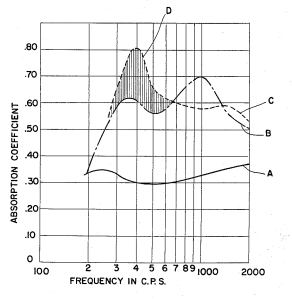
absorberThis open cell foam can be used as an acoustic absorber, fiber free and non-combustible. I guess this is still a unique product. This application was patented in 1963 and it is shown that some extra holes are made in the cellular glass to absorb better  the lower frequencies (curve B compared with curve A). The absorption is even better with these holes in the back side of the sample (curve C).

The use of hydrostatic pressure  is a difficult step in mass production. It would be much better if we could foam directly a 100% open cell foam from waste glass. At that moment, we would have a unique product at a low cost.

freibergIn the race to the holy grail vacuum cellular glass, there is a discussion about which thermal conductivity could be reached. In my opinion, lower than 0.021 W/mK is not possible today and this open cell material in a vacuum bag below 0.1 mbar could prove that.
I suggested this once on a meeting in the University of Freiberg, Germany. A certain well known glass professor claimed  that manufacturing  an open cell foam in the above way is not possible, the foam should be reduced to dust. I guess that was what we call today an “alternative fact“.

Calculating summer heating with U-value.net: a fantastic website

logo_smallRecently, we discovered a website about the calculation of the U-value of different configurations. The website works in German and only the introduction can be red in English.

ralfplagThis website, between the many U-value calculators, is very interesting for the following reasons:

  • The website is developed by Ralf Plag, a physicist working on elementary particles with an interest in building physics. He can be considered as a neutral person, which will not favour a particular material.
  • Not only the U-value is calculated but also humidity issues and, very important, summer heating. Indeed, we all know that a room under an insulated (light) steel roof with rather low U-value can still be unpleasant warm in summer.

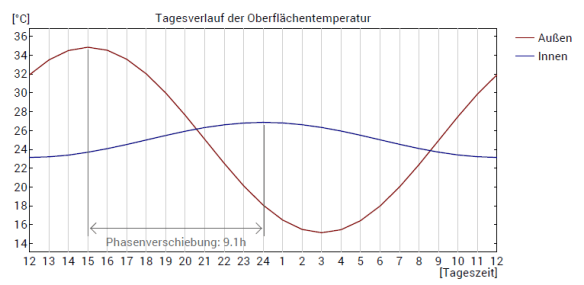
For this we took the example of a U=0.15 W/m2K roof, insulated with cellular glass. In one case, we insulate with 27cm ZES cellular glass (0.042 W/mK) and in the other case, we use 35cm GLAPOR cellular glass. Although a 0.15 W/m2K roof functions in both cases well in winter, both configurations perform very different in summer. For both cases, we show the shift of the temperature wave and the amplidude reduction as calculated by the site.

glapor

GLAPOR directly foamed from recycled glass


cellularglas0042

ZES cellular glass foamed with special glass composition


We observe that the cellular glass, directly foamed from recycled glass (GLAPOR) has a 80% larger amplitude reduction and a more interesting phase shift compared to cellular glass, foamed from a special melted glass composition. It is clear that both configurations behave the same in the winter but that the GLAPOR roof behaves a lot better in the summer. On top of that, GLAPOR  cellular glass has a cheaper production process (no melting of a special glass) and is for that reason more ecologic.


New patent about vacuum cellular glass

logo_smallVacuum cellular glass is the holy grail of the thermal insulation world. Indeed, this thermal insulation should have a thermal conductivity of 0.021 W/mK, non-combustible, vapour tight, water tight and has rather larger compressive strength. But up to now, nobody found the holy grail …

Nevertheless Dr. Kaufmann, IfL Ingenieurbüro für Leichtbau GmbH & Co. KG,
09113 Chemnitz, Germany took a patentapplication on this subject. The patent makes a reference to another patent about VIP thermal insulation.

Dr. Kaufmann seems to be inspired by this type of thermal insulation, which has a very low thermal conductivity below 0.010 W/mK but is known to be easily damaged. With cellular glass, it is expected to get a much more robust type of  VIP.

The patent describes how the sandwich should look but without a description how to produce. A open celled foam should be sealed with a glass layer or a foamed glass layer or a polymer layer or a combination. The open cell kernel should be evacuated to get the very low thermal conductivity before sealing. Another option is to fill the open cell kernel with a noble gas.

We have the following comments on this patent application:

  • Today, nobody has a low density recept for open cells except opening a closed cell  foam with a hydrostatic pressure. Higher density foams have a higher thermal conductivity through the glass matrix, compensating the benefit of a vacuum.
  • The thermal conductivity of air or another gas drops at a pressure of 0.1 mbar, which is a vacuum difficult to maintain without pumping. Sealing with a polymer material in this case is not possible because the diffusion of most gases in the air is way too large.
  • Sealing with glass or cellular glass on cellular glass without heating is today an unknown technology.

Today, this patent cannot be realized industrially and the obtained thermal insulation will never have a thermal conductivity below 0.020 W/mK (of the order of conventional PIR).


On the resistance against bending of large cellular glass boards

logo_smallIn the previous blog, we were discussing large cellular glass boards, which are recently available. In that case, the own weight of a board may induce bending up to breakage and for that reason, we have to consider a minumum thickness.
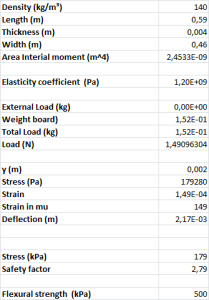
bending06Today, there are still small boards on the market. For example, in case of 59 x 46 cm boards with 140 kg/m³ density, the boards have to be only 4mm thick to sustain its own weigth with a span of 59cm. The minimum thickness is about 3cm, so bending under its own weight was never an issue. It explains why flexural strength gets much less attention than compressive strength.

But for GLAPOR boards 280 x 120 cm at 140 kg/m³ density, the situation is different. In this case, we need a thickness of 10 cm to have a safe resistance against bending under its own weight. Like shown in the previous post, the picture shows 10cm boards 280cm x 120cm.

GLAPORlogo

For the same reason, people, dreaming about even larger boards to reduce even more production cost, have to be carefull. Indeed, for the case of 4m wide boards, we need 20cm thickness to have a safe resistance against bending. Like can be calculated, annealing of 20cm in continuous foaming involves a very long lehr due to the large annealing time. This case could be non realistic. We expect however that soon production lines will be built with two ribbons of about 3m width, which are foamed and annealed in the same furnace to reduce largely production and investment cost.

bending28     bending40

The above shows that flexural strength will become an important property for cellular glass due to the new large GLAPOR boards on the market. But we observe that large boards have to be thicker due to bending stress. In that perspective, it makes sense to consider cheaper cellular glass like GLAPOR boards with a slightly  higher thermal conductivity, because thickness is already needed against bending stress.
Large monolithic cellular glass boards are now on the market

logo_smallToday, GLAPOR is proud to announce the first delivery of large boards: 280 x 120 x 10 cm cellular glass boards PG900. These large boards are another advantage of the continuous foaming method compared to the mold process.

GLAPOR _logoIndeed, the continuous foaming project was developed at GLAPOR for three reasons:

  • Lower production cost
  • Improved ecology
  • Larger dimensions

The first two have induced the enormous success of GLAPOR cellular glass boards on the market but it seems that the actual booming will be reinforced by the availability of large dimensions.

large boards.jpg

Large monolithic GLAPOR cellular glass boards are non-combustible (EUROCLASS A1) and reduces labour cost and joints on actual job sites. It seems that the “ready home” building market is interested to use these boards to construct passive housing walls with thermal insulation built-in.

Today, GLAPOR cellular glass boards are the only thermal insulation which can be delivered monolithic up to 280 x 120 cm x 18cm, being non-combustible (EUROCLASS A1), vapour tight and water tight and sustaining up to 2000 kPa compressive load.


About cellular glass in Glass International

logo_smallGlass International Magazine is a monthly magazine for scientists and engineers in the glass industry. It handles about furnaces, process and more to produce glass and glass articles like windows, bottles, …. Thermal insulation was generally never covered but this is changing due to the importance of thermal insulation for the world.

Glapor cellular glass was invited to contribute about cellular glass and used this GLAPOR _logoopportunity to explain that 7 cellular glass dogma are out of date.

  • NOT TRUE: only small dimensions are available
  • NOT TRUE: cellular glass is expensive
  • NOT TRUE: more ecologic means even more expensive
  • NOT TRUE: a plant involves a large investment
  • NOT TRUE: long production lines with a large ecologic footprint are necessary
  • NOT TRUE: the market for cellular glass will remain at 1% of the total thermal insulation market.
  • NOT TRUE: the latest new technology is not available on the market

glass-16-bigThese dogma are indeed out of date and confirms the title, choosen by the Glass International Editor, Greg Morris: Cellular glass enjoys a comeback.