 Recently we found cellular glass R&D in Romania, more specific at the Technical University in Timișoara. In the following, we mention two papers.

Arjen Steiner
The first paper describes a glass foaming process with fly ash and SiC. They reach densities down to 500 kg/m³, which is still quite high. The addition of fly ash is quite new in this perspective. In this system, not only glass but also fly ash is recycled. Leaching out tests confirm that these foams have enough chemical stability to be used as thermal insulation. Arjan Steiner made a thesis about foaming fly ash from municipal waste as already mentioned in a previous post.
In a second paper bottle and flat glass is foamed with 3 to 10% waste plaster. Also in this case, densities down to 500 kg/m³ (6% plaster) are reached with an acceptable leaching out test. These foams can probably be used as cellular glass gravel thermal insulation, while thermal conductivities of 0.12 W/mK are reached.
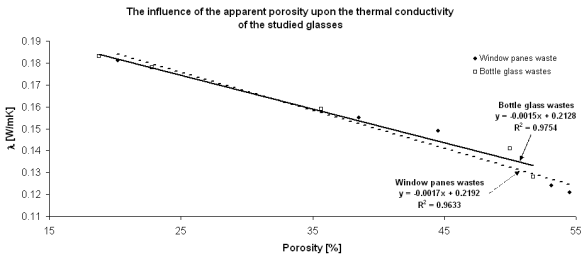
The above papers convert a maximum of waste to ecologic cellular glass thermal insulation. Indeed fly ash, plaster waste and waste glass are crying to be recycled in a second life.
 I like to dedicate this post to Danny Huwé , a Belgian journalist who was killed in the beginning of the Romanian revolution, which was ignited in Timișoara, the city where the above R&D was done.
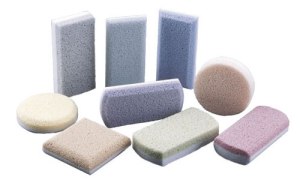
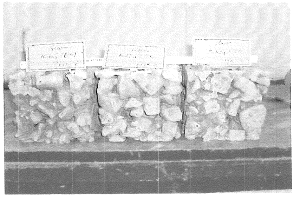
 But if we use “white” glass and a white foaming agent, we can produce a white foam. With the addition of pigments, all kind of colors can be given to the foam, like shown in the picture. Today, these foams are requested as “gravel” for decorative purposes and can be delivered by
  However, the use of colors in cellular glass is not new and is used for year by
  insulation has to be load bearing. Today, cellular glass is the only candidate for this task.
 To be able to install the GLAPOR cellular glass blocks, hot bitumen or a bitumen felt can be used. According to their
  The above production line runs with fine powder waste glass, mixed with calcium carbonate and is heated with gas from landfill.
  In fact, the roots of plants are settled into the Growstones, while all neceassary ingredients are introduced diluted in water. It seems that Growstones are the best material for this kind of hydroculture due to the best balance of water holding capacity and air filled porosity.

 A good choice is
 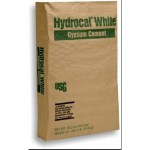 For higher temperatures,
  The above products are well suited to coat cellular glass used for facades but in contact with the inner space of the building. Indeed, more and more, building project developers are looking for alternative building systems without any combustible thermal insulation, mould and rodents. Large dimension
 To demonstrate the above we have a report (
 One of the nicest examples of landscape construction with
 The glycerin / water glass foaming agent is an alternative, which foams in a neutral atmosphere (high combustion efficiency) below 800°C, without generating any dust thanks to the water glass. This foam can be cut or broken after foaming without inducing any decoloring or other damage, which is important for gravel and board production. For board production from a continuous ribbon, annealing becomes a lot easier due to this cutting after foaming because temperature gradients only acts on the sawed stroke and not on the full ribbon. On top of that, the water glass improves the sintering behaviour of the glass powder, which is translated in a reduced grinding of the glass cullet.
 Therefore, we came interested to find the brilliant inventor of this process. We found a
  The patent mentions that the organic foaming agent has to be dissolved in the water glass which is basically the reason why it can be used in a neutral atmosphere and sawing / cutting is possible at higher temperature without burning out of the foaming agent causing decoloring of the foam. Glycerin is the typical example of an organic foaming agent.
 In the Koning Albertstraat, an old building (1880) was bought for renovation by
  This high density cellular glass (160 kg/m³, about 300€/m³) is installed without (bitumen) coating and for that reason a lime mortar is needed. Compressive strength of cellular glass and mortar exceeds largely 2000 kPa. All the cellular glass, used in this project is manufactured for 100% from waste glass, unsuited for the production of new bottles or windows.
 Although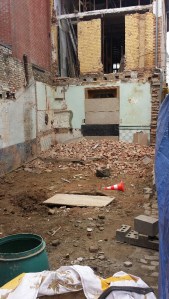

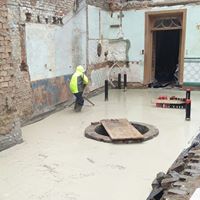
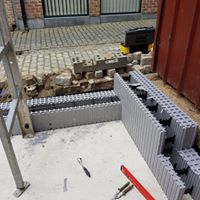
 At the other side, R&D was performed to find more direct applications of recycled glass and cellular glass gravel was developed. First SiC was used as a foaming agent for gravel but this process involves higher foaming temperature above 900°C and has a tendency to induce open cells (crystallisation) when a too low density was the target. Gravel is continuously foamed on a steel belt which has a short life at 900°C and higher energy consumption. In my opinion, this SiC process will disappear due to the high energy cost and short belt life as a consequence of the high foaming temperature.
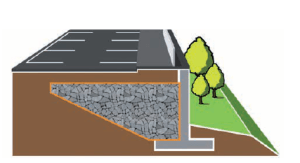 A smart (Bulgarian?) individual developed the glycerin / sodium silicate process for gravel, which was already reported in a
 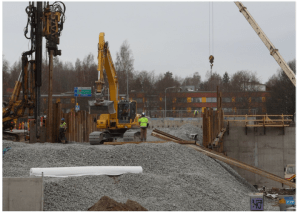 The following files can be downloaded from their site.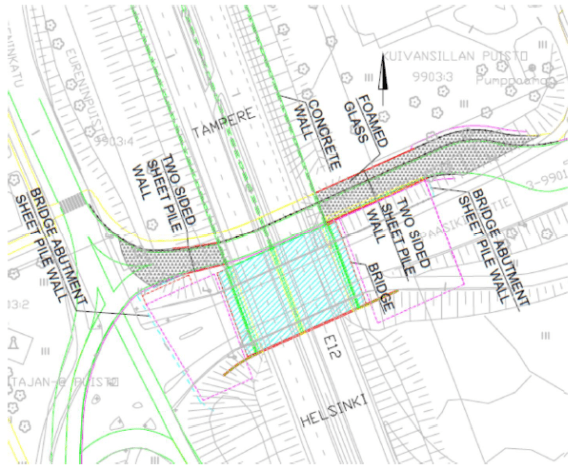
 However, recently in Norway another method is used due to the availability of large monolithic cellular glass boards 2.8m x 1.5m x 0.18m from
  Later on, the large assembled
  The construction of the 25cm thick insulating roof panel is shown in the pictures. In our opinion, the future of cellular glass is to be used for large self supporting panels instead of only insulating structures. For the last option, plenty of low stiffness alternatives like XPS, EPS, MW, … are available. This future for cellular glass was born when
  BELGLAS BV