Preparation of the foaming powder

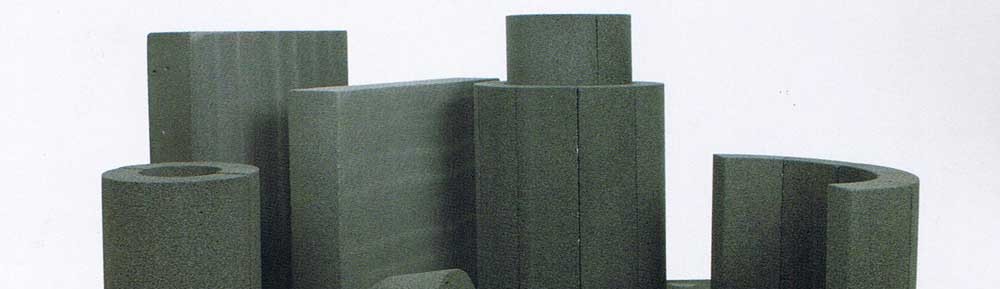
logo_smallThe production methods, mentioned in this block are examples of the powder method. Indeed, the glass is ground to a powder, a foaming agent is included and the powder mixture becomes sintered later on at about 650°C. At this point, we have glass with a built in foaming agent.

Grinding of the glass is an important part of the production process. For the grinding of glass and other brittle materials, we have a lot of different possibilities but the old fashioned ball mill is the most popular one. Engineers will study and choose between the different equipment to find the most efficient ones. Scientists will more try to change the glass surface in the direction of more efficient grinding. This blog is written by a scientist and for that reason, the concept grinding aid is mentioned.

The readers, hitting the “grinding aid” link, have download a nice (but old) paper about grinding additives. The paper learns that

  • Only about 1% of the energy in a ball mill goes to actual surface creating.
  • 20 kWh/ton is a typical energy consumption.
  • Less than 1% carbon black improves the grinding of cement with 30%.

Carbon black is already mentioned in this blog. It is used as a foaming agent for glass because it is very fine carbon, which can be well distributed over the glass surface. Because it is also a grinding aid, it makes sense to add it already in the ball mill.

In the gravel methodology, it is the common practice to grind the glass without any additive and to mix the foaming agent with the glass powder afterwards with special equipment like for example Eirich mixers.

Some people doubt that a ball mill can  mix with the same quality as an efficient mixer but others mix in the ball mill and do not invest in these mixers. I am sure about one thing: this knowledge is the key to a superior cell structure like for example the Neoporm ware shows to us. Mixing and grinding is still 90% empirical knowledge, which means that the solution is hard laboratory work.

Foaming agents which are also effective grinding aids are favorites in this business. That is probably the reason why carbon black was hard to replace.

Composition, synthesis and properties of foam glass obtained from waste container glass

logo_smallThis paper, about a year ago published is another proof that the race for the best cellular glass, based on waste glass without remelting is really going on. The research is done at the university in Sofia in Bulgaria. Indeed, East Europe is doing a lot of effort for cellular glass today.

The paper reports on the use of glycerin and water glass for the foaming of the container glass. What do we learn?

  • They start from 6000 cm²/g glass powder while another source mentions 8000cm²/g.
  • Glycerin is used as foaming agent.
  • Also water glass is needed although the role is not clear.

But they also report a thermal conductivity of 0.02 W/mK. I doubt that this is possible and for that reason, I have my doubts about the measuring system C-Therm TCI. These dynamic cheaper systems are popular these days but BELGLAS advises to work with the stationary systems for thermal conductivity measurements. In a future blog, we will report again on that subject.

I am looking forward to measure a real 0.042 W/mK on a cellular glass plate, foamed from not remelted waste glass. In my opinion, that is the way to go.

The inverted roof reinvented

logo_smallThe inverted roof has its water proofing membrane under the thermal insulation. On the contrary, a cellular glass roof has in principle this membrane on top of the thermal insulation. For example GLAPOR cellular glass blocks are “swimmed” in hot bitumen to get a vapor (and water) tight system. This is nicely shown in the following YOU TUBE movie.

And indeed, the water proofing membrane is the weak point in the construction. UV-light and large temperature variations are causing the rather short life time of the membrane. In case of a leak, not visible inside, freeze and thaw on the cellular glass will damage irreversibly the roof in a few months over a large thickness.

On top of that, some cellular glass insulation becomes rather expensive when a large thermal resistance is requested, which is the standard today.

The inverted roof with XPS does not know these problems. Current producers are DOW, BASF and KINGSPAN. But this roof has another possible problem. During rain fall in the winter, cold water may reach the water proofing membrane, cooling the structure under the water membrane proofing. This may induce condensation inside if the structure is not very heavy. For this reason, BASF, synonym for German quality, requests to have a minimum thermal resistance  of 0.15 m²K/W.

This thermal resistance is already availbale with 1cm GLAPOR PG700 cellular glass but 4cm is needed to have enough mechanical strength for installing. For just 6€/m² extra material cost, you have the best of both worlds.

  1. An absolute protection against humidity problems inside
  2. A very well protected water proofing membrane
  3. A huge thermal insulation with cheap XPS without any problem possible

6€/m² or less than 600€/m² for a 200m² house (one stock) is giving you absolute protection against humidity with a cheap very well insulating inverted roof, with its never to replace water proofing membrane.

Indeed, this is the inverted roof reinvented or the best of two worlds: CG + XPS (CG = cellular glass; XPS = extruded polystyrene). It is the conviction of BELGLASCZ that the combination of different thermal insulations is giving you the best systems.

Making a thesis about cellular glass

logo_smallMaking a master and doctoral thesis was my best time during studying physics. It should be nice if again more students should perform research on cellular glass beyond the constraint of making profit. In this post, I mention three nice studies:

  • Dr. Arjen Steiner made a study about the conversion of fly ash from a municipal solid waste incinerator into useful foamed glass. He did this work at the Technical University Eindhoven in the Netherlands. This student was responsible for the project in this previous post.
  • Dr. Rudolf Trinkner studied the cell structure and calculated the mechanical stability of foamed glass and compared with experiments. The work was done at the Technical University Zurich, Switzerland.
  • Dr. Selamet Kose made a nice work about the foaming mechanisms of glass with special attention for SiC as foaming agent. This work is very practical and contains cell gas composition measurements with a gas chromatograph. Also the relation of the cell structure with the thermal conductivity is calculated. This work is also done at the Technical University Zurich, Switzerland.

Especially the last thesis is important for the development of cellular glass, foamed from waste glass with alternative foaming agents.

BELGLAS would be pleased to help new PhD-students all over the world in their research on cellular glass.

A book to read: Cellular Ceramics, Manufacturing, Properties and Applications: ISBN: 3-527-31320-6

logo_smallIf foamed glass is your passion, you should study the above book. Looking to glass foams as an example of a ceramic cellular structure is broadening your mind. The table of contents looks as follows, where you can also download a part of the glass foam chapter as a seducer to buy the book.
WILEY-VCH WEINHEIM, GERMANY
1 Introduction
1.1 Cellular Solids – Scaling of Properties
1.2 Liquid Foams – Precursors for Solid Foams
2 Manufacturing
2.1 Ceramic Foams
2.2 Honeycombs
2.3 3D Periodic Strutures
2.4 Connected Fibers: Fiber Felts and Mats
2.5 Microcellular Ceramics from Wood
2.6 Carbon Foams
2.7 Glass Foams
2.8 Hollow Spheres
2.9 Cellular Concrete
3 Structure
3.1 Characterization of Structure and Morphology
3.2 Modelling Structure-Property Relationships in Random Cellular Material
4 Properties
4.1 Mechanical Properties
4.2 Permeability
4.3 Thermal Properties
4.4 Electrical Properties
4.5 Acoustic Properties
5 Applications
5.1 Liquid Metal Filtration
5.2 Gas (Particulate) Filtration
5.3 Kiln Furnitures
5.4 Heterogeneously Catalysed Processes with Porous Cellular Ceramic Monoliths
5.5 Porous Burners
5.6 Acoustic Transfer in Ceramic Surfac Burners
5.6 Solar Radiation Conversion
5.7 Biomedical Applications: Tissue Engineering
5.9 Interpenetrating Composites
5.10 Porous Media in Internal Combustion Engines
5.11 Other Developments and Special Applications
Concluding Remarks

Russia goes (foamed glass) gravel

logo_smallI found a nice message in my mailbox. Indeed, Schaumglas Global Consulting managed to install a plant for the production of 300 000 m³ foamed glass gravel annually in Russia. Recycled glass can not be used in the regular glass industry if it contains all kind of contamination. In case there is a large request for foamed glass gravel, it is economic wise to use this waste glass without too much cleaning directly into foamed glass gravel.

Today, the further we go to the East, the larger is the growth of foamed glass, gravel and boards, while in West Europe, a foamed glass plant was recently closed. What should be the reason for this? More than 80 years ago, foamed glass was invented in Russia but that can’t be hardly the reason for this sudden growth and interest.

Patent study: US 2011/0302961 A1: METHOD AND AUXILIARY DEVICE FOR PRODUCING FOAM GLASS

logo_smallThis patent application US20110302961 describes a continuous foaming method without cutting or sawing. Also in this case, continuous foaming on an endless belt is used but the glass/foaming agent powder is put in segments on the belt. In this way, the resulting foam is segmented. The individual blocks are lift up to a vertical position and introduced in a lehr. This lehr is essentially a hollow glass lehr. In this way, the total setup can be also much shorter than in the case of a horizontal lehr.

But the patent also gives a nice summary of the current state of the art. In my opinion, the foamed segments will not be flat and this process will generate a lot of waste due to extra cutting.

The idea to anneal vertically remains an important point due to the huge saving which can be generated by reducing the length of the lehr. But on the other hand, the ribbon width will be limited in that way because forced convection has also its practical limits.

If a suitable land can be found (length, flatness, ….), BELGLASCZ advises to work with radiation / natural convection cooling of a wide ribbon like developed by CNUD EFCO. All methods to work with a shorter lehr end up with more waste. It was suggested to use this waste for foamed glass gravel, but the added value of that product will always be  much smaller than boards.

Kinetic energy absorption by cellular glass in the Formule 1 racing world

logo_smallMay 1, is the day we all think on the tragedy of this very skilled and friendly F1 driver Ayrton Senna. And that is probably the reason kinetic energy absorption crossed my mind in my previous post, although the idea was already published in a US2981317 patent about safety seats in 1961. In this post, I want to show my point with real numbers with a calculation in an Excel spreadsheet.

The following example could be tested. I assume a car at 300 km/h and a total weight of 1000 kg. I guess that this car hits a cellular glass wall and a cross section of 2 by 0.2 is really hitting the cellular glass wall. The used cellular glass has a compressive strength of 3 N/mm². The car will stop completely after crushing 3 m cellular glass and the deceleration will be about 250 g. A Head Injury Criterion (HIC) of 250 g should be the limit for concussions. An internal recoil of the brains will not be present because the cellular glass is entirely non-elastic, the kinetic energy is converted in breakage energy for the cellular glass.

Cellular glass, produced from only recycled glass (without remelting) by for example GLAPOR can be used for this application, costing less than 450 € for one running meter. The cellular glass is non combustible, can always be recycled and is water proof. Having an idea is always easy but only the F1 organization can bring it into real life. Bernie, please wake up.

Other applications for cellular glass

logo_smallThe first application of cellular glass was a floating device. During the war, harbors must be protected with curtains against submarines. The Germans had occupied Portugal, the major source of cork and closed cell cellular glass was the best alternative.

Later on, cellular glass became popular as a thermal insulation and this is today the real market. But it can also used as an acoustic absorber, today sold under the name REAPOR®. An acoustic absorber avoids echo, which is for example always a problem in open offices.

A less known application is to use it as kinetic energy absorber. Kafka, the famous Czech writer invented the principle of a helmet during his work for an insurance company. But a helmet can not avoid that the brains have an internal recoil, although your head is well protected. This recoil is a consequence of the elastic behavior of the helmet.

But if this helmet should have been constructed from cellular glass, your head will crush the cellular glass but there will be no internal  recoil and brain damage would be less likely. The use of cellular glass as a kinetic energy absorber was already published in  US2981317 patent of 1961 about safety seats at line 49. The specification non-elastic crushable is clearly given on line 46.  The same is needed when a Formule 1 car looses control and hits the tires along the road. The recoil of the brains of the pilot can be the reason of medical problems afterwards although the outside damage can be relatively small. I am curious to know   what density the cellular glass needs to have and which thickness is requested to let stop a car at 120 km/h without even a headache  for the driver. I guess we will find reasonable values. The calculation can not be difficult: the kinetic energy of the car is used to crush the cellular glass = thickness * compressive strength * cross section of the car.  The maximum allowed deceleration gives the compressive strength you need. Solution will be given in a next post.

Thermal conductivity measurements

logo_smallAlthough cellular glass can have many applications, 99.999999% is going to thermal insulation. A good bench-marking of thermal insulation needs good equipment to measure and well trained operators. In this post, I give a short introduction with emphasis on the assumptions, which are made when a certain thermal conductivity is published.

Quality control (QC) needs a fast but reliable measurement for a decent quality assurance (QA). Indeed, the more measurements are done, the better the distribution of the thermal conductivity values around the average can be described. This becomes awarded with an improved declared thermal conductivity.

A very fast equipment is the hot wire method. This transient method is measuring in fact the thermal conductivity and volumetric heat capacity. The method is sensitive for only a small area of the sample (a few cm³) and in that way very sensitive to inhomogeneities and contact resistance. For a cellular material with cells on the scale of a mm, this looks not the appropriate method for the QA of cellular glass. On the other hand, it looks like a fine system to gather the thermal data needed to calculate the annealing curve.

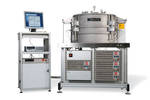
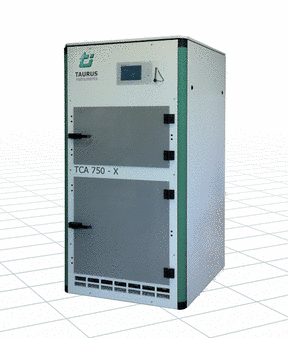
TaurusThe heat flux meter method (HFM) is a more reliable method because the sensor measures typically up to 30 x 30 cm from the sample and the full thickness is taken into account. Typical samples are measured in a few hours with an accuracy up to 0.5%. The system uses a heat flow sensor, built as a many serially connected thermocouples. A sample is installed between a hot and cold sink. The sensor is mounted on the cold or hot sink or both. Because some heat leak to the outside can not be avoided, the system needs to be calibrated. HFM systems built in a cabinet with a stable and controlled temperature are not dependent on the laboratory conditions and have my favor. They need less calibration and more time is available for the actual measurements.

Taurus and Netzsch have both reliable systems, when properly calibrated, need about 2 hours to measure a 4 cm thick sample. Both give confident measurements in a bench marking but I would also put some attention on the robustness of the equipment. Measuring cellular glass can be very hard for this kind equipment due to the scratching surfaces and the unavoidable dust.

The quality of a HFM-measurement depends strictly on the quality of the calibration procedure and so on the quality of the calibration samples. It is well known that a calibrated sample changes slightly after each measurement due to thickness changes. Each confident cellular glass producer should have access to a system, which allows a perfect absolute measurement. In that way, confident calibration samples can be used.

NetzschThe Guarded Hot Plate method guarantees that all the measured heat flows through the sample and does not escape to the outside. This is done by working with a guard ring, kept on the same temperature as the actual measuring range. This system needs much more time to measure one sample (about 12 hours) but does not need calibration if certified thermocouple wire and self calibrated volt meters are used. Such a complicated system should be able to measure a large temperature range. In that perspective, I am charmed by the GHP 456 Titan® ,if adapted for larger samples.

The very small error of the GHP-system is calculated with finite elements by L. Troussart in “Analysis of errors in Guarded Hot Plate measurements as compiled by the finite element method”.