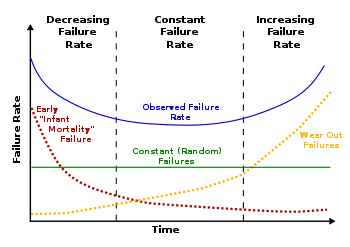
 The bathtub curve is used for many subjects where an estimation of the remaining life is needed. It was used to estimate the best time to change an air conditioning or even to estimate the creep of steel. The last application was the motivation to try this concept on the creep of cellular glass. It was brought to my attention by G. Crevecoeur.
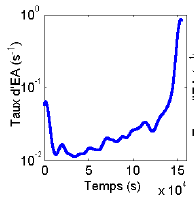
 The creep of cellular glass can be very sensitively monitored with the acoustic emission technique (AE) like shown in this paper. There we mentioned that creep on cellular glass can be described with a bathtub curve. We were combining Omori’s law (power law in time) with an exponential, which describes the damage already done in the foam due to the creep and so increasing the load. We found that if we fit the AE-signals with this simple bathtub curve, we can safely describe the mechanical stability of the cellular glass on the long term. Twenty years back, this statement was not really accepted.

 But recently, a book appeared on the market about estimating lifetime with AE, with a reference to our paper. Googling the authors brought me to a PhD thesis about this subject, applied on composite materials. In this thesis, I found power laws and bathtub curves. The bathtub curve was also inspired on Omori´s law for earthquakes but the exponential is rather complicated.

 In the references, I found also Prof. Didier Sornette. Didier became an expert in the prediction of catastrophes, like earth quakes and financial bubbles. I know him because he was the one who downgraded the above paper from Physical Review Letters to Physical Review. The reason was that we had written in the original paper title “self organized criticality”. Later on, he recognized that earthquakes are self organized critical due to the fractal nature of the tectonic plates like we had argued for the microscopic defects in cellular glass, showing exactly the same statistics.
 Didier was not really a friend of Per Bak, the inventor of self organized criticality. In fact, Per had a lot of discussions with theoretical physicists like him but he loved experimental guys, which are testing (and hopefully) confirming his theory. When I informed Per about our results, he kindly asked me to publish the data in a high level magazine. Per passed away much too early but he left us a fantastic book: How Nature Works: The Science of Self-
 Organized Criticality. Like acoustics, you need a logaritmic scale to describe the intelligence of people. Per has a few octaves more than most other people.
 I learned once the tool AE from Prof. Wevers, KU Leuven during a workshop, organized by my (ex-)father in law, Jules Heirman. We collaborated in a few papers about this technique on cellular glass. She was well informed about our interpretation of AE with bathtub curves. Great was my surprise when I discovered the following paper about AE on creep of masonry, interpreted by the bathtub curve, published ten years later than ours. The following picture says everything.
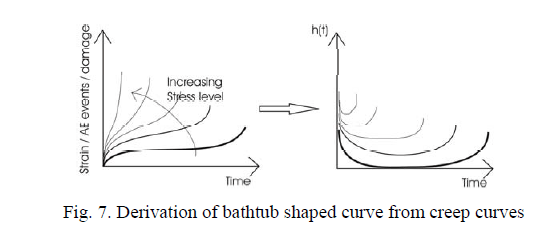
 There are generally two kind of bright scientists. The one who recognizes the work of less intelligent industrial scientists and the one who seems to have a blackout about this. Prof. Godin, AE expert in composite materials at Mateis, Lyon, does not know me but refers to our work twenty years later. I must be honnest, my ego got a boost.

 and I can “loose” a lot of time by just checking the main page.
 This software is written in PHP and works together with a (open source) database. But is less known that this software can run on your personal or company server where you can develop your own documentation system. Indeed, a PC under Linux can run this software for your private documentation system at home or in the company. BELGLAS can assist you in starting such a documentation system where each document gets its own comments in order to find it when you need it (when you already forgot you made it). The software is free of charge like all open source.
 One of the most popular languages today is beyond any doubt
  The language runs on Windows, Linux, Unix, Android and probably more operating systems. The Internet is full of
  We wish you a nice adventure with Python. And it is true, the writer Guido answers all emails.
 Both products are used to solve mathematical problems with numerical methods. Everything is based on matrices but standard programming, like done with C and FORTRAN is also included. It is a script language, which means that every command is first interpreted and then executed , contrary to FORTRAN or C, where compiled programs are executed.
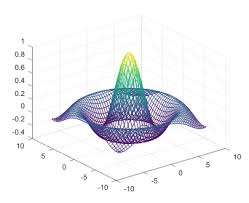 Developing a solution for a problem goes much faster with this software but execution is slower than with FORTRAN. If a certain solution works well with Octave but execution is too slow, reprogramming partially or completely is an option. The plotting software is also very easy to use and writing or reading data to/from a file is straightforward. A lot of Octave programs are already available in all kind of technical disciplines.
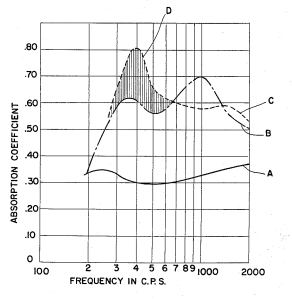 This means that 1m² of this material is equivalent with an open window of 1m² for the noise in a room, which is almost perfect. In another
  Glass is a fully recyclable material that can be recovered in a closed loop over and over again. This is particularly true for g
 AeroAggregates LLC is the first vertically-integrated, U.S.-based company to produce lightweight aggregates from 100% recycled glass. Our manufacturing capabilities include the ability to make several types of foamed glass
 The basic problem to live on Permafrost is the stability because there is an active layer, which is melting every summer. Building on this layer makes that the building is continuous sinking into the underground.

 The new system replaces the active layer (about 1.5m) by cellular glass. Cellular glass is weight light, can support the building and 1.5m cellular glass avoids perfectly that building heat penetrates into the permafrost. Another advantage is that a climate change hardly influences the permafrost under the building. In that way a lot of concrete has been avoided.
 For this application, we don´t need cellular glass with the lowest thermal conductivity, which means that cellular glass, directly foamed from recycled glass will satisfy. This cellular glass can be prefabricated from large boards of 2.8 x 1.2m, today only produced by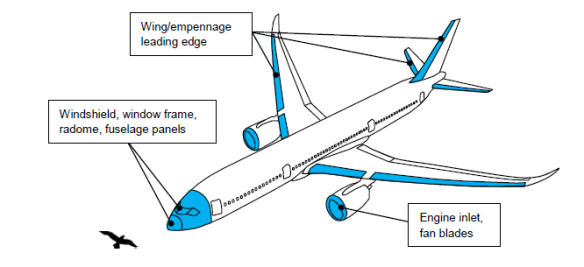
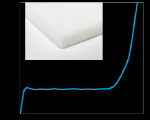 The article also shows the load deformation curve of the perfect kinetic energy absorber. This curve is typcial for foams and indeed also for cellular glass when the compressive strength measurement is done without capping. Indeed, the typical peak at the beginning of the flat part is absent for foams but not for honeycumbs.
 The article shows also a graph with the specific kinetic absorption of foams, which do and do not comply with what is needed. The typical foams of polyurethane, polyisocianate and polyethylene do not comply, even at densities of 100 kg/m³. But on the other hand,
  The
The 

 BELGLAS BV