Sculptures made out of cellular glass

logo_smallI am well aware that professional sculptors will not be interested. They use hard and noble materials like stone, hard wood, bronze, … . But I think now on sculptors, who lost part of their craft by a handicap. I can imagine that they still “see” what they want to sculpture but have not the force anymore.

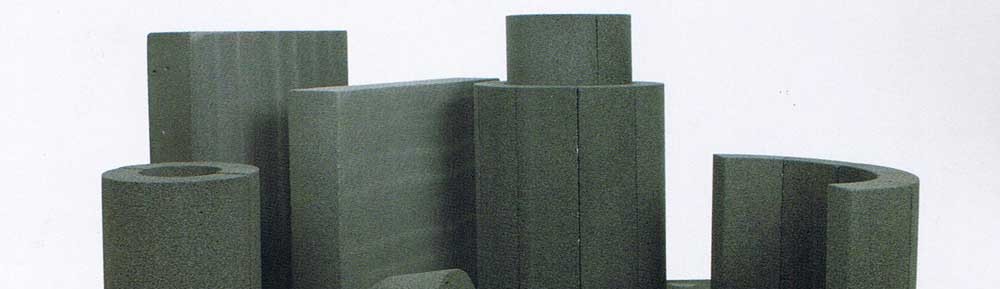
In that case, cellular glass could be an option. It is easy to shape with simple tools. It is possible to start from a large block by gluing with for example bituminous or polyurethane adhesive. Errors can be easily corrected with the same technique.

After shaping, the sculpture can be finished with a rendering product, suited for cellular glass.  A further marble look is even possible with an extra layer marmolux on this rendering.

10 years ago, I made a 1m high lighthouse for a friend lighthouse collector. The cellular glass was finished with UNILIT 65 from Telling, UK. The typical color was given with a lime paint. The structure was glued with UNILIT K on a concrete block to give it stability against wind. Like today confirmed, after having being outside for 10 years in the Belgian climate with rain, sun, snow and frost, the “sculpture” is still in good shape and will be perfect after the yearly cleaning.

And the price (200€/m³) is also interesting compared with granite, which is of the order of  4000€/m³. Maybe, cellular glass can be used as a “test” before expensive granite is used.

WP_20160109_001

Collection Carlier-Lenaerts

Transport of cellular glass

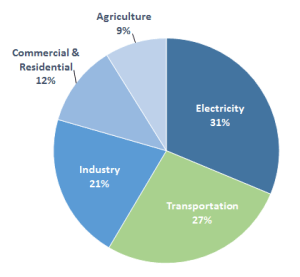
logo_smallTransport is assumed to be for a large part responsible for the climate change. On the other side, it is common practice to transport cellular glass, produced with ultimate ecologic care, several 1000 km to a job site with environment unfriendly trucks. And we all know that cellular glass is 5% solid material and 95% gas.

sources-transportation

A European truck with lorry has an internal load volume of 157 m³ and loaded with 120 kg/m³ cellular glass, we get a load of maximum 18000 kg. A typical truck + lorry has a weight of 15000 kg. As a consequence the tool to transport has about the same weight as the load. On top of that, the load is a watertight and water resistant product that floats on water.

Not using transport with boats is in fact Kafka because transport over water of a floating product should have almost a negligible energy consumption.

M8 ships are equivalent with 32 “trucks + lorry” and can be fully loaded with cellular glass (about 600 Ton while 2050 Ton is possible). Compared with trucks, the energy consumption is about 20% and personnel cost is negligible (about 5%).  With good logistics, there is also no time issue. On top of that, bigger ships (M12), equivalent with 58 trucks are in the picture today.

On these M8 ships, we could install photo voltaic panels for a peak power of 125 KW, while these ships, if loaded with cellular glass (low load) can do their job with a 600 kW motor.  I guess (but it is a wild guess) that an important part (50%) of the transport could be CO2 neutral.

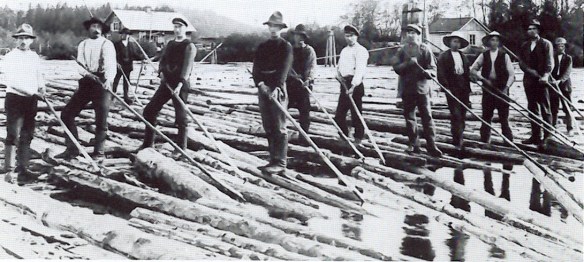
Maybe, it is possible to put the cellular glass (like log driving in the past) directly on the water, avoiding the investment in a boat, only a “pusher boat” is needed.

Today, the economic logic favors 100% truck transport because there will be always a truck transport between water and job site. This handling is today not well organized. But the economy becomes greener every day which means that the ecologic and economic logic are becoming the same. Ships, specially designed for the transport of cellular glass to the job site and transport of recycled glass / raw materials to the plant have to be considered and designed. One day, humanity has to live with only sunshine as energy source.

Loggers_klaralven


The race to the best thermal conductivity

logo_smallNot so long ago, a thermal conductivity of 0.025 W/mK was considered as very good. But today, it is possible to buy 0.005 W/mK and it seems that the market is interested.
This super insulation, called VIP, is very fragile because it is in fact a moderate vacuum bag, filled with a nano porous material. A little damaging and the thermal conductivity increases to 0.025 W/mK. Changing dimensions is not possible due to the vacuum and also the life time is limited due to the thin bag, which allows always a certain diffusion.

I was teached that the market is always right but marketing is a strong weapon which is able to put the market on the wrong leg. Is the market stupid? Windows makes a lot of money with the WINDOWS operating system and OFFICE suite while LINUX and LIBRE OFFICE are free of charge. Free of charge Android was able to pass IOS but GOOGLE has a strong marketing machine. It seems that only strong marketing is able to let happen what is logic.

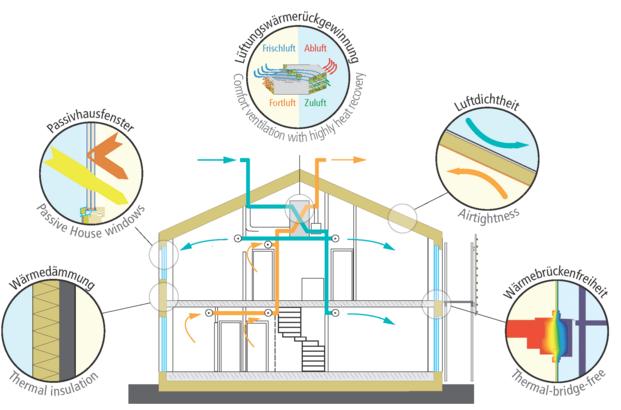
In the building industry, Ytong (Xella) was the first building material which was insulating and load bearing. With a thermal conductivity of 0.090 W/mK and U= 0.15 W/(m²K), we get walls of minimum 60 cm thickness for passive housing. The price is typically 96€/m³ or 58€/m². The same job can be done with cellular glass GLAPOR PG900.2 (0.055 W/mK) boards up to 3×1.5m at 73€/m². The last one has as bonus water- and vapor tightness. For comparison, VIP-insulation has a cost of 224€/m² for the same U-value, while VIP-insulation is totally not load bearing.

For a 1 stock house of 200 m² in 10 x 10 m, we arrive at 500m² or 40000€ for the construction materials (GLAPOR) in case we use an intelligent shape. Better insulating materials without load bearing capacity need extra construction materials. A the end, the construction is much more expensive if the market joins the race of the best thermal insulators. Efficient marketing needs to promote the use of load bearing thermal insulation for the building industry. With large GLAPOR boards, passive house construction can be done at very sharp prices.

For the building industry, I believe that the race for the best thermal conductivity is like an F1-race. At the end of the race, you are back at start, there is not any evolution. The race for the best thermal conductivity is a useless race for the building industry.

passive


How to foam glass when natural gas and crude oil are out of order?

logo_smallWe know that natural gas and crude oil will be gone within maximum 100 years. I am sure that I will not “enjoy” this situation but I guess everybody wants to be the Elon Musk in its own field. And yes, the world should be happy with this kind of guys, because the others (we) were able to consume in 150 years what earth could save in about 4000 million years.
The energy, radiated by the sun can be converted in electricity by absorbing wind energy, due to temperature gradients on earth and by solar – electricity converters using photovoltaïc or ORC on a liquid, heated with sunshine and parabolic mirrors.

For the production of glass, the technique of electric melting with electrodes, injecting energy in the liquid glass is well known. For the glass foaming, electric heating seems logic but some recipes need a reducing atmosphere, generated with gas burners, feeded with an excess of natural gas. That will be a problem which can be solved by the techniques, used in the tin bath of a float glass plant. Other recipes, like the GLAPOR – method, are foaming in a neutral atmophere and electric heaters can simply replace the burners.

But the energy density of gas burners is a lot larger than the one of electrical heaters. Working with a longer furnace (and longer foaming time at lower temperature) is of course possible but we can also consider the old fashion wood gas (syngas).Wood gas was used during World War II, where natural gas and crude oil were not available and is proven technology. The gas can be liquified to have a certain buffer. Today, technology with more performance is available, even as a hobby.

This mixture (syngas) of H2 and CO is obtained by gasifying wood. A rather limited wood (700 ha for 100 000m³ / year cellular glass ) is able to produce enough energy to drive a cellular glass plant in a constant way. If cellular glass plant and wood production are combined, losses due to energy transport are eliminated while the foaming of the glass is in that case CO2 neutral. On top of that, foaming recipes with a reducing atmosphere can also be foamed.

However, converting wood in wood gas to foam the glass is in fact an avoidable step. I am dreaming now about a layer of fine ground wood (pellets), a layer glass powder / foaming agent and a top layer of fine ground wood. This sandwich is transported on a belt, turning around  in a furnace, electrical or wood gas heated, just to compensate the heat loss through the furnace walls. The burning of the wood induces the foaming of the glass in the most efficient way possible. This last idea can easily be tested in a small furnace.

The durable thermal insulation cellular glass, saving tons of CO2 during use can be produced in a CO2 neutral way from just sunshine and waste glass. This cellular glass can be used to build the shell and floor insulation of durable passive houses with a wooden & plaster board inside structure, eliminating the use of cement. Solar cells (photo-voltaic and water boiler) on the cellular glass shell and Elon Musk’s Power Wall batteries inside the house are generating the energy needed for a comfortable living in a CO2 free way. The whole climate catastrophe is in fact pure bad will of human kind because the above is certainly not rocket science. Nevertheless, the bunch of climate negationists, supported today by a certain Donald Trump,  have also the legal right to have their opinion. Elon Musk for president, I call him tomorrow.
image

OLYMPUS DIGITAL CAMERA

Houses which can be built entirely with cellular glass

logo_smallIn previous blogs about self supporting structures and the possible height of these structures, it became clear that typical family homes can be built entirely in cellular glass without bricks, wood or concrete for the outside structure. Only for the foundation, some concrete would be necessary. This cellular glass structure should pass the standard for passive housing.
The best structure should have the curve of a reverted chain, hanging between two points to eliminate tensile or bending forces and to make optimum use of the large compressive strength of cellular glass. Such a curve is called a catenary, described by a hyperbolic cosinus. To be honest, the word “catenary” did not belong to my vocabulary untill now.
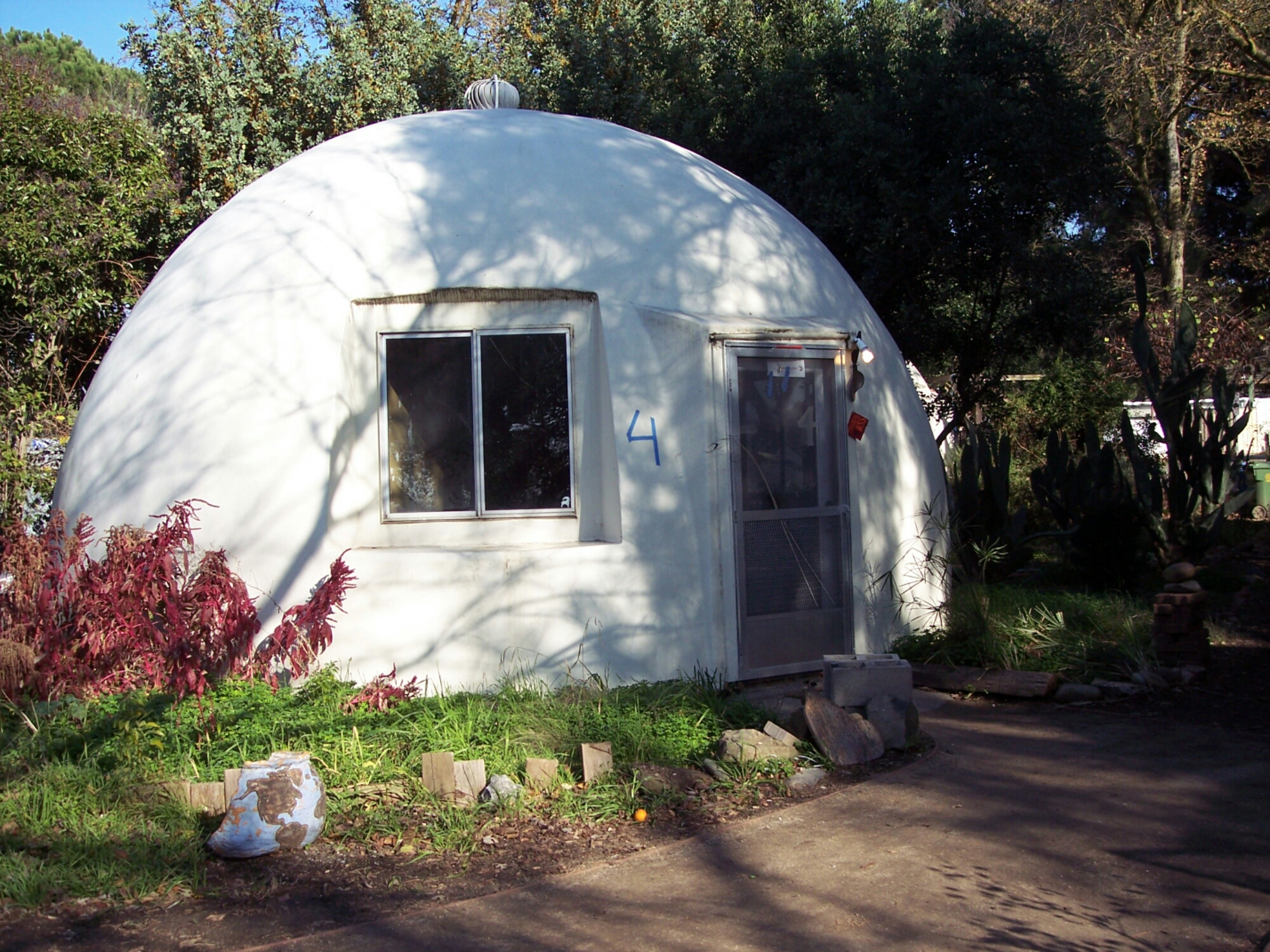
However, googling with “catenary house” learned that others were already attracked by this shape because it is indeed a very strong structure, which resists better storm and hurricanes. Built with cellular glass, the structure is strong, thermally insulated and water tight. It can be even installed (partially) under the soil to minimize even further the ecologic foot print and to be perfectly protected against more and more frequent hurricanes.
In the following, some pictures and websites are given.
image
image

image
We selected two small and a larger home. In both cases, the catenary dome can be entirely manufactured with cellular glass, being wall and thermal insulation at the same time.

A tower of cellular glass

logo_smallOnce we speak about self supporting structures of cellular glass, which are implicit thermally insulated, the next question raises: what should be the maximum height of such a structure under earth’s gravity?

I estimated this for a cellular glass with 2000 and 1000 kPa compressive strength by calculating the stress under the weight of a cellular glass tower and compared this with other materials. We use the short time compressive strength (or creep stress for wood and steel) and as a consequence, such a high tower is not stable on the long term. However, in the case of pg900 and pg2000, a safety factor = 3 is on the safe side to remain under sub critical crack growth.

towerThe PG900 is commercial available material from GLAPOR, as is the Ytong C2/350. The other materials are standards available at many suppliers. We see that other materials than cellular glass are not necessarily much more self supporting due to their higher density. Wood, developed by nature is very stable in the strongest direction.

Self supporting structures in cellular glass of about 400m height are stable. If we reduce the height to typical home heights, a lot of strength is available to hang the inside structure if a shape is used where only compressive stress is present by using an intelligent curve like a catenary.

OLYMPUS DIGITAL CAMERA