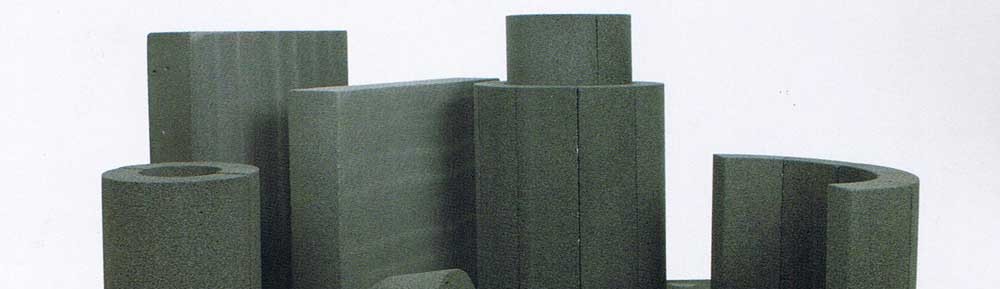
Glass can be foamed in a mold or on belt (continuous foaming). A mold is typically made from stainless steel because foaming temperatures may be up to 950°C. Heating transport at these temperatures is primary by radiation while stainless steel acts as a mirror for radiation, it has a low emissivity. On top of that, glass at 800°C has a tendency to stick on steel. This sticking can be eliminated by a coating based on kaolin or another fine refractory oxide but remains always critical. In case of even minor sticking, stripping the block from the mold may become difficult.
BELGLASCZ suggests to perform an experiment with a mold coated at the inside and outside with EMISSHIELD. This ceramic coating is nanotechnology with as primary function to increase the emissivity to 0.95 . It is available for refractory ceramics, steels and aluminium. The glass world knows this product today for the coating of the superstructure in glass melting furnaces to improve the energy efficiency. CNUD EFCO uses this product on stainless steel to improve the efficiency of the heat exchangers (patented) and to lengthen the life time of a NiCr heating coil (patented). An EMISSHIELD coated heat exchanger absorbs the radiated heat much better while the coating also protects against corrosion like published in Innovating flat glass lehrs.
An EMISSHIELD coated mold can be considered as transparent for heat and this should allow to work with a lower furnace temperature and more homogeneous heating. In this case, the flue gases will be colder and less energy will be consumed. We also expect that coating protects against the furnace atmosphere lengthening the life time of the steel. If also the walls of the foaming furnace are coated, we can expect an energy saving of minimum 5% next to a longer life time of the mold due a more homogeneous heating and protection against the furnace atmosphere. In an experiment, CNUD EFCO showed that float glass does not stick on coated heating wire at 1000°C and it may be expected that sticking of a glass foam on steel will be less likely. CNUD EFCO has all the equipment to construct and coat molds for the foaming of glass. More information can be obtained at hans.strauven@cnudefco.com.
Improving molds for glass foaming
Reply
 BELGLAS BV