Patent study about a cellular glass gravel bitumen mixture

logo_smallThe company Aeschlimann filed a patent  EP2657302A1 about the production of a mixture of cellular glass gravel and bitumen. The patent is motivated by the following arguments:

  • The layer will absorb much less humidity because the bitumen is covering the cell surface and filling the voids. In this way, we should have a much better frost resistance.
  • The compressive strength, typical about 0.8 MPa for cellular glass gravel increases up to between 2MPa and 3MPa. In this way, a lot more applications for cellular glass are becoming possible.
  • The patent gives a few situations where this invention can be used.

bitumen-gravelThe patent describes also a plant, which is able to perform the mixing.

Hot bitumen and cellular glass

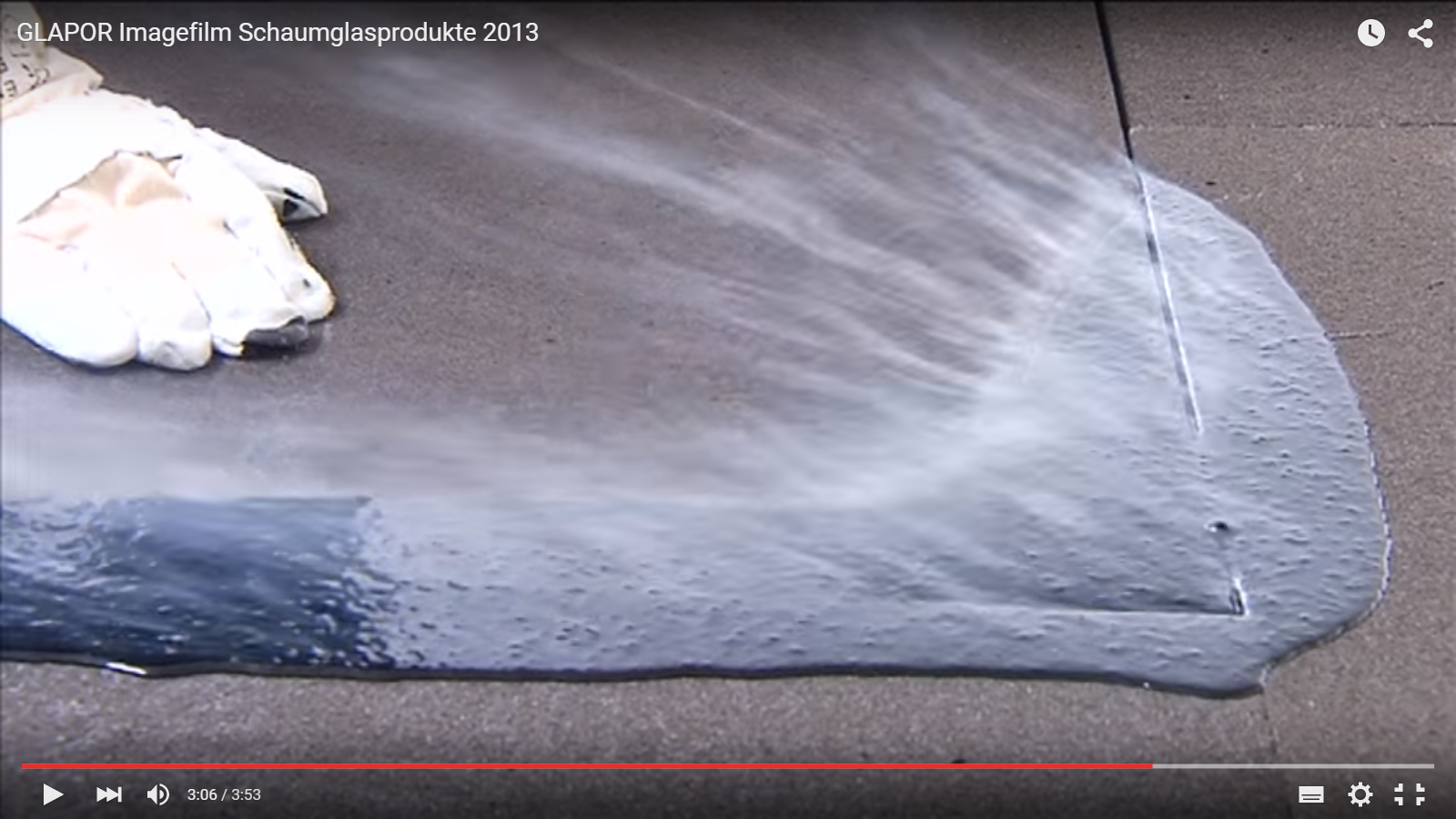
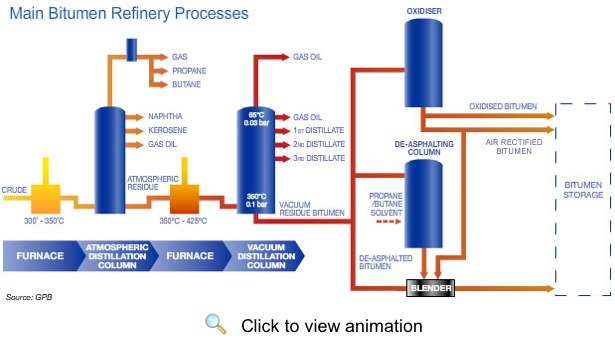
logo_smallHot bitumen (or asphalt) is still the advised solution to install cellular glass on a roof. A movie of GLAPOR shows how the plates are almost submersed in the viscous liquid. The result is a vapour tight thermal insulation, avoiding any internal condensation and resisting large wind loads. For cellular glass roofs, typically bitumen 85/25 is used, which is an oxidized bitumen. These bitumens have superior characteristics, which are important for a flat roof. Most bitumen originates from crude oil and can be considered as waste during the production of gasoline, diesel, … .But it has also important disadvantages:

  • In order to liquefy, we have to heat it above 180°C, which induces always a fire risk on the job site.
  • To heat it up, we need a heating equipment on the roof, which needs always attention.
  • The hot liquid can of course induce severe injuries on the skin when hot.

But there are also serious heath risks. Oxidized bitumen is by the IARC, part of the World Health Organization , classified as “probably carcinogenic to humans” (Group 2A). The other bitumens, namely the ones for mastic work and road paving have a lower classification: “possibly carcinogenic to humans” (Group 2B).

It is now the target to find an alternative, which is liquid without heating during installation of the cellular glass boards and hardens very fast to allow the installation of the next layer. On top of that, it has to be cheap like bitumen. Personally, I doubt that the joints can have a lot of internal condensation and for that reason, I suggest to consider a ceramic alternative based on natural hydraulic lime.

bitumen-glaporbitumen

Extrapolating the mechanical properties of cellular glass

logo_small Like already shown in a previous post; the course notes of Lorna Gibson at MIT allow us to extrapolate the mechanical properties of cellular glass.

The mechanical properties of cellular glass can be described with

  • the elastic or Young modulus
  • the shear modulus
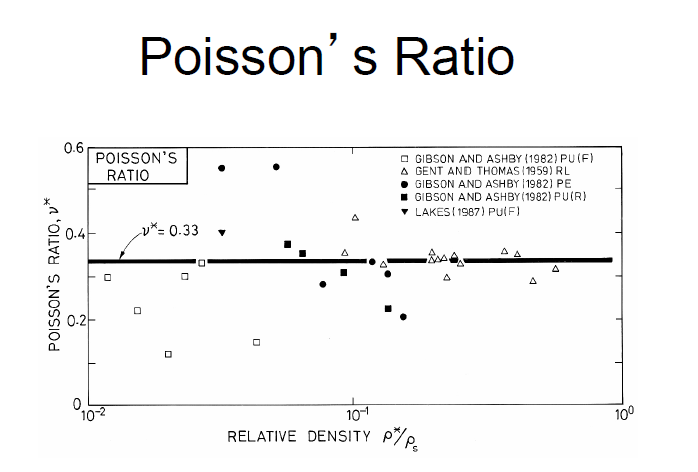
  • Poisson’s rato

The course notes give these properties in function of the density.

gibson3gibson4gibson5

Young and shear modulus depend quadratic on the density while the Poisson’s ratio seems density independent. The best guess for the last one, independent of the base material  is 0.33 .

Thermal insulation foams

logo_smallIt is always interesting to see how other look to the market you like to get. Lorna Gibson, famous MIT professor, gives a lot of courses about cellular solids. The course notes are public domain and are nicely organized in an MIT-website.

In this post, we discuss the notes about thermal insulation. The paper gives a list of thermal conductivities with solid materials like polystyrene, polyurethane, glass, with gases and also the resulting foams. It shows that glass foams have a higher thermal conductivity because glass itself has a higher thermal conductivity.

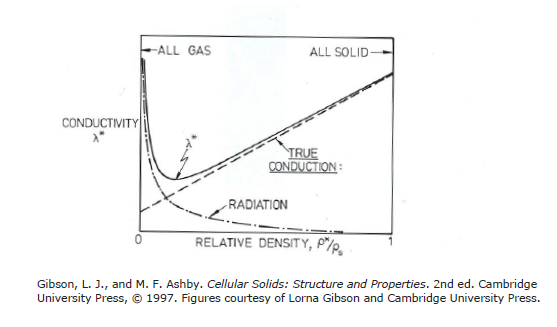
gibson2The paper discusses the different heat transport mechanisms and shows that foams with 1mm cell size have no contribution to convective heat transfer. The paper explains also why at too low densities the thermal conductivity increases. It seems that the contribution of radiation becomes too important.

As a consequence, it seems that not only the compressive strength but also the thermal conductivity induces an under limit on the density. It seems that a relative density of 0.04 or 100 kg/m³ density is an under limit.

Lorna Gibson

Prof. Dr. Lorna Gibson

Further improving cellular glass

logo_smallToday, the best cellular glass is for example produced by ZES FOAMGLASS. ZES 500 has an average thermal conductivity of 0.038 W/mK at a density of 110 kg/m³ and an average compressive strength of 500 kPa. Other thermal insulations can have thermal conductivities halve the above value. How can we improve cellular glass?
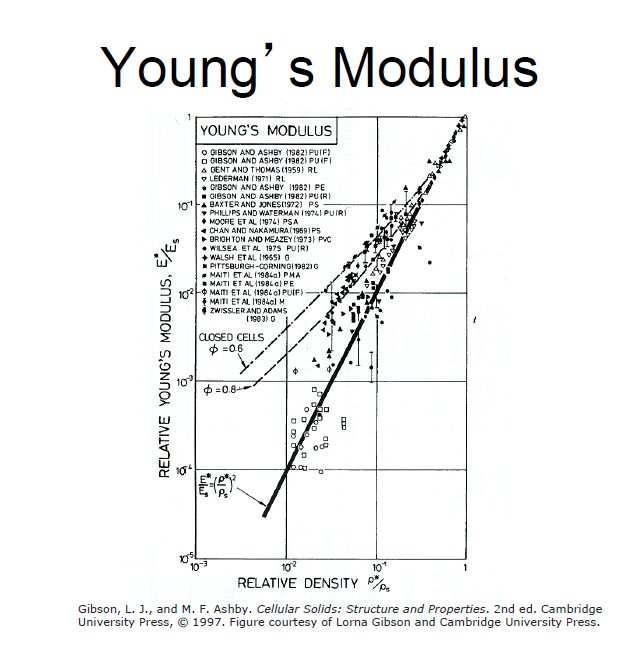
gibson1Lowering further the density is probably not an option. Even if we keep a fine cell structure, the compressive strength lowers quadratically with the density like shown in this graph from the paper from Lorna Gibson, famous MIT professor and cellular solids expert. Indeed, we can assume the compressive strength is linear with the Young modulus because glass breaks at a certain strain above the static fatigue limit, independent of the density of the cellular glass.

Besides the solid heat conduction in the glass, we have the gas thermal conduction and radiation. Radiation can  be improved by more walls absorbing and radiating or an improved cell structure.

Gas thermal conduction is sensitive to the weight of the molecules. If we assume that we have only CO2 in the cells with a carbonaceous foaming agent like carbon black or glycerin, we can improve with a receipe generating SO2. Indeed, CO2 has a thermal conductivity 0.015 and SO2 0.009 W/mK like shown here. But I doubt that an SO2 containing foam will be popular.
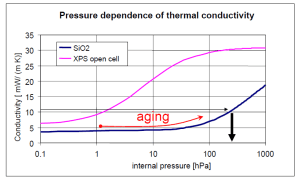
XPS-vacuumInducing a vacuum in the cells could be the solution. For example, open cell XPS, evacuated to 10 Pa has a large improvement like shown in the graph of this interesting paper of the EMPA institute in Switzerland. It looks simple but a vacuum of 10 Pa is not easy to generate in a fine cells foam. This low pressure is needed to get a situation where the mean free path of the gas molecules is a lot larger than the cell size.

But the graph shows that the thermal conductivity of XPS with air (0.031 W/mK) decreases to 0.007 W/mK with the vacuum. The difference = 0.024 W/mK is the thermal conductivity of air. If we apply this on a cellular glass (0.038), filled for 100% with CO2 (0.015), we arrive at the lowest thermal conductivity = 0.023 W/mK possible for cellular glass based on soda lime glass.

In principle, we can dream about the following material:

  • stable thermal conductivity = 0.023 W/mK
  • compressive strength = 500 kPa or permanent load = 250 kPa
  • absolute vapor tight
  • free from water absorption
  • non-combustible
  • extreme good ecology balance due to the use of waste glass without remelting
  • 150€/m³

I guess this nice dream is a nightmare for the other thermal insulation materials and after 70 years cellular glass, I doubt it is realistic. But it is maybe not impossible ….
On the static fatigue limit of cellular glass

logo_smallThis topic is important when the strength of cellular glass becomes an issue. Cellular glass has a much larger strenth than organic foams and in a lot of cases, a glass foam is selected for this reason.

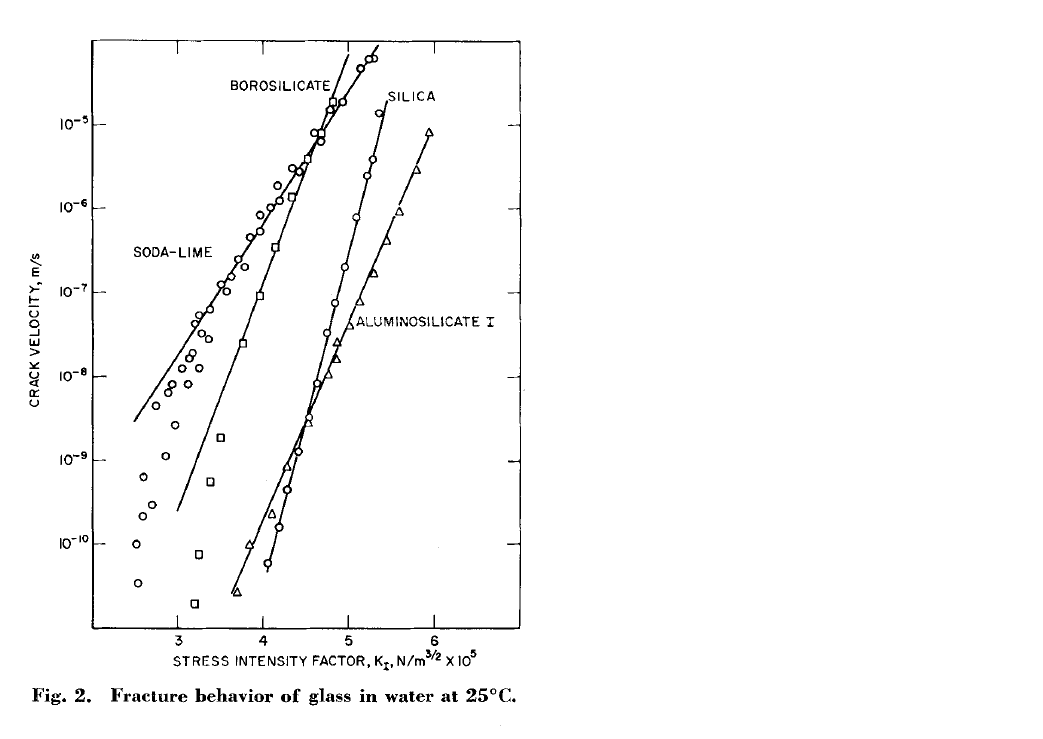
A very important basic paper in that perspective is written a long time ago by S. M. WIEDERHORN and L. H. BOLZ . They discuss the static fatigue limit of glass already in 1970. Recent measurements with an atomic force microscope are confirming the original ideas.

staticfatiguelimitBoth papers show that glass has a static fatigue limit, which means that below this limit, a crack does not grow at all. It is also shown that this limit is decreased with water on the crack tip. Soda lime glass is the weakest glass, borosilicate is better while aluminosilicate is the best. The following figure became the standard in this field.

As a consequence, cellular glass is able to resist a load for ever if the static fatigue limit is not exceeded. This safe limit can be measured with acoustic emission like shown in another paper.

The graph also shows that between very slow (or no) crack growth and fast crack growth about a factor 2 is present for soda lime glass. This could be seen as the material factor between the short time compressive strength of GLAPOR cellular glass and the possible load on the long term. 1000 kPa compressive strength ware resists in principle a load of 500kPa forever.

PhD thesis at Rijksuniversiteit Groningen, The Netherlands by Cihan Tekoğlu

logo_smallIf we think about steel or wood or any other material, the dimensions of the sample should have only a negligible effect on the measurement result. The reason is that the sample is orders of magnitude larger than the grain size of the steel or the cell size of the wood. In other words, the continuum theory applies.

However, if we consider cellular solids with a cell size of the order of millimeters, a sample of a few centimeter may show side effect, influencing largely the mesurement.

In this theoretical thesis, the different calculation methods are discussed to handle this problem. This may be important as a theoretical base for writing standards, EN or ASTM, where the dimensions of the samples are defined. It gives also an answer  which deviations like holes can be accepted.

Master thesis at Imperial College, London by Song, Xiaoguang

logo_smallI found a first draft of this  work but I am still looking for the final version. The student did some foaming tests according to the powder method without clear description of the foaming agent. He investigated the effect of the particle size distribution with fast and slow heating and obtained remarkable results.

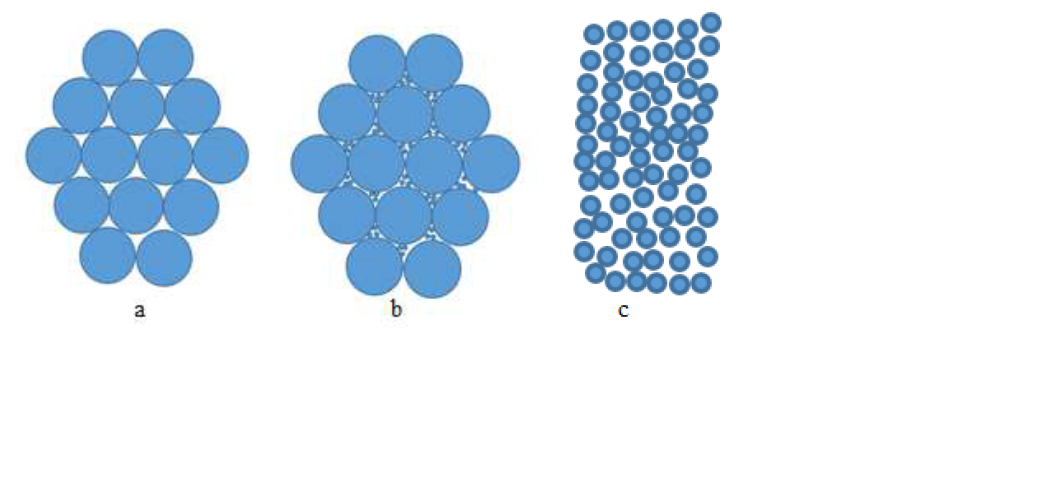
He worked with fine and coarse powder but also with a mixture. He found that mixture gives a higher density for the green sample.  But also that a much better foaming is present during fast heating of this mixture compared to the fine and coarse particle powder.

xongThe last observation is remarkable and he used the following picture to explain the phenomenon. It suggests that working with a mixture of fine and coarse powder is giving a better cell structure. I think this really a new idea: working with a two peak particle size distribution to improve the cell structure.

Nice review article from the university of Padova, Italy

logo_smallI already mentioned an interesting book with a very important chapter. The authors G. Scarinci, G.Brusatin and E.Bernardo made a nice work about the history of glass foams with the focus on glass recycling.

  • Different techniques are mentioned but the powder process is today the favorite method.
  • They make reference to a number of patents and are describing the currently employed methods.
  • A list of different starting glasses are given with emphasis on recycled glass
  • The particle size of powder and foaming agent are discussed in relation to the cell structure but unrealistic thermal conductivities are given.
  • Foaming temperatures and time are given with carbon black as foaming agent
  • The cooling rate is discussed without taken into account the thickness, which is not logic.
  • Different foaming agents are discussed based on thermal decomposition and by reaction. Even SO2 is mentioned as foaming gas.
  • The different glass foam products are listed: gravel, blocks and pellets with their properties.
  • Alternative processes are discussed with a chapter about foaming CRT-tubes.
  • Last but not least, an impressive list of references is present with many interesting patents.

This review article is a fantastic introduction for people interested how glass foaming improves ecology.

The happy marriage of cellular glass and natural hydraulic lime

logo_smallNatural hydraulic lime is much less known than cement although it is much older. It has the same function but sand particles, bounded with cement form stronger parts than bounded with natural hydraulic lime (NHL). However a wall, made from bricks and NHL lime is able to deform after many years without developing a crack. Walls made with a cement mortar always generate a crack in case there is deformation due to insufficient foundation. Today, most people have forgotten that stable buildings can be made with bricks and NHL-mortar without using any cement. A very good book, written by the Prof. Dr. Ir. Koen van Balen, KU Leuven is an introduction in this matter, although written in Dutch. It handles about all kinds of lime in comparison with cement and remembers us that NHL-mortars without any cement are the only tool to renovate old historical buildings. Indeed cement mortars on old bricks are inducing cracks in these bricks.

Cement mortars on cellular glass are always a risk due to the very high drying stress exceeding the tensile strength of cellular glass. Organic additives can be added to cement mortars to induce some flexibility or the cellular glass surface cells can be filled with an organic flexible material like bitumen before applying cement mortar.  NHL-mortars have even in the dry state a kind of plasticity, probably generated by micro cracks, allowing deformation of the walls of old historical buildings and avoiding too much drying and thermal stress on cellular glass. Such a mortar could be the TD1320, produced by Tassulo in Italy.

Such a mortar has a compressive strength exceeding 2.5 N/mm². GLAPOR high density cellular blocks with compressive strength > 2 N/mm², sawed on the dimensions of typical bricks can be mounted on the foundation of one stock houses with this TD1320 mortar to insulate the foundation cold bridge and to avoid diffusion of soil water into the wall.

Another application could be to cover and strengthen the cellular glass with a NHL-based coating in order to have a hard surface with a minimal thermal expansion mismatch. GLAPOR, to our knowledge the only supplier of 3m x 1.5m cellular glass plates, can in that case replace wood and other materials when weight or / and combustibility are an issue. This is typically the case in ships, air planes and other places with a low fire loading.

But last but not least, NHL-based rendering products are a perfect solution for the finishing of non-combustible outside thermal insulation like GLAPOR cellular glass. This was already mentioned in a previous post.

It is my personal believe that the cellular glass world has to replace any organic accessory by a ceramic equivalent, where the flexibility comes from load distributing micro cracks like products with an NHL-bonding agent.