3D printed house with GLAPOR cellular glass

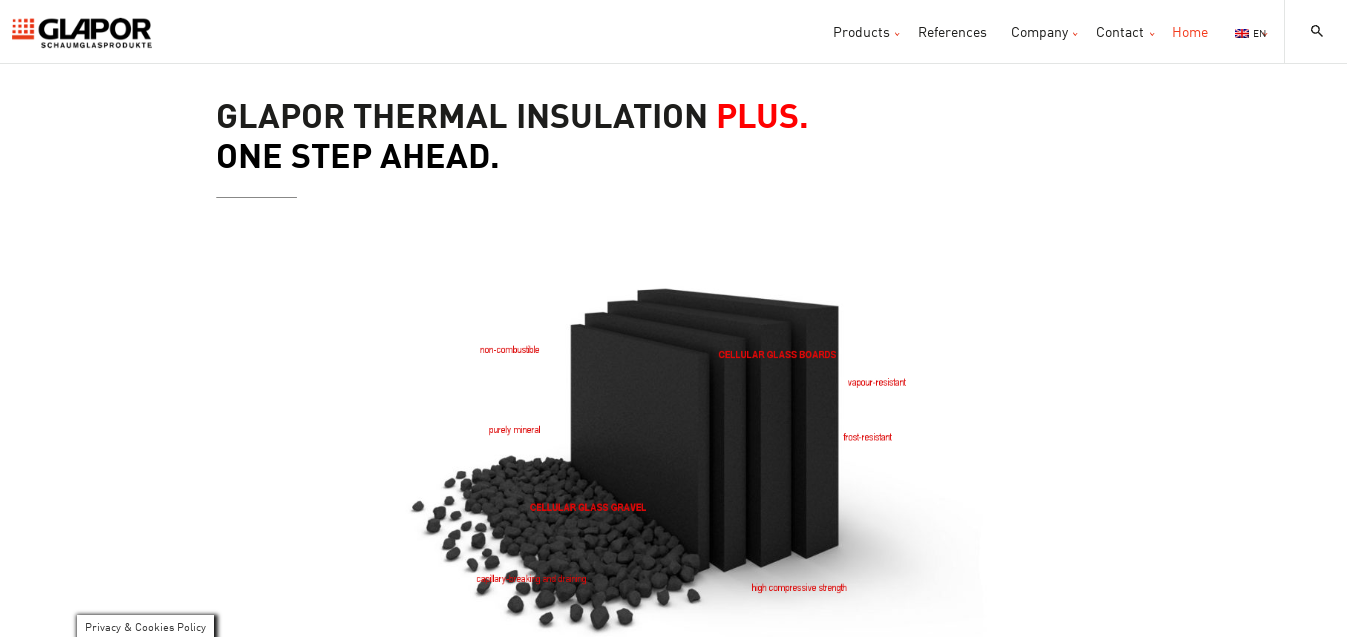
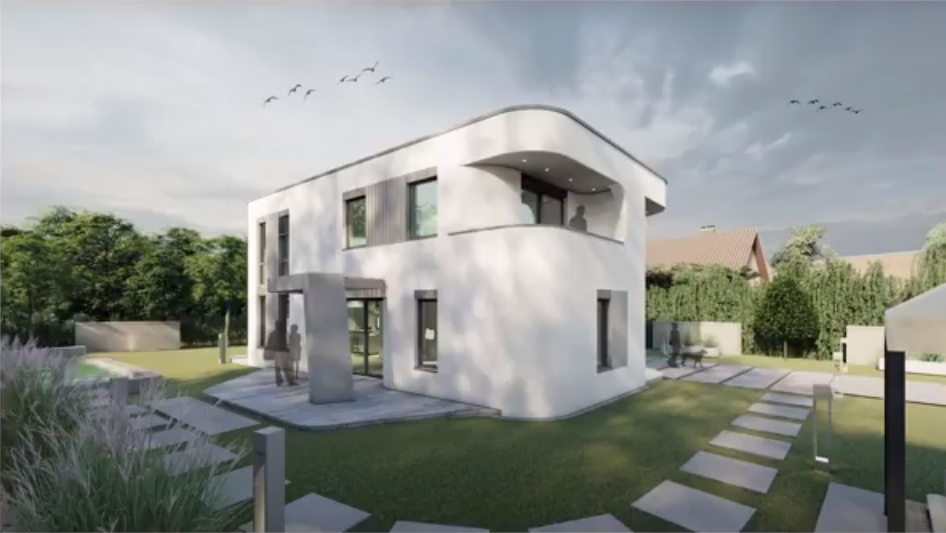
Recently, a nice YouTube-movie appeared about full printing a 3D-house. The house was put on GLAPOR cellular glass gravel, while the flat roof was insulalted with GLAPOR-boards.

The movie shows the use of cellular glass gravel and the printing of the house, layer by layer. In fact, the house was printed by only two people and a huge cement mortar printer. The challenge was to develop a mortar, which allows printing but which does not flow after printing.

On the flat roof, GLAPOR cellular glass boards were installed with bitumen. Although, the main target was to use only mineral materials, bitumen, as an exception on the rule, was used to have a firm adherence to resist important wind loads.

More information about the printing can be found in another YouTube movie.

The first cellular glass producer in Iran

Cellular glass in Iran

The company Jahan Ayegh Pars in Isfahan, Iran started with the production of cellular glass due to its unique properties and because it is was hard to get in Iran. I am a little bit surprised about the name because they must be aware about Pittsburgh Corning.

Just like IZOSTEK , STESS and GLAPOR, a family take the initiative to develop a process and build the production facility. Further, they organize succesfully a sales environment. In this case, the company already produces mineral wool, ceramic wool and PIR industrial technical insulation.

In this case, I also measured the gas composition in the cells to check for closed cells and to estimate the thermal conductivity, which is not published. The cells are indeed 100% closed and I estimate the thermal conductivity to be 0.046 W/mK for the 115 kg/m3 density and 600 kPa compressive strength. Although recycled glass is used without remelting, JAP achieved a low H2 content below 3%. In view of the low energy cost, labour cost and recycled glass use, I estimate the production cost of this material between 50 and 70 €/m3. In the Middle East, such a producer can be a game changer. A chromatogram is given hereunder.

We are 100% sure that we hear much more about this porducer in the near future.

Glass literature

To understand fully the unique properties of the different types of cellular glass, it makes sense to read some more didactic books for glass science. I found these books on the Internet and I guess I am allowed to mention them.

The first work I like to advise is the under graduate student book of James E. Shelby. I got sympathy for the book by its definition of a glass: A glass can be defined as “an amorphous solid completely lacking in long range, periodic atomic structure, and exhibiting a region of glass transformation behavior”. Any material, inorganic, organic, or metallic, formed by any technique, which exhibits glass transformation behavior is a glass.

The second work is a little bit more academic. About glass is a shorter but more difficult version of the above one. 

Cellular glass can be foamed from different glass compositions. The history of the glass composition is the perfect introduction how the world evolved from colored glass beads to optical fibers. This topic is interesting because cellular glass is the best method to recycle all kinds of glass. 

Linux on an USB-stick

Knoppix is well known as a live-LINUX in Germany, which allows to taste LINUX on a CD or DVD, without writing on the hard disk of your PC. Any possible damage on your Windows-system is excluded. Klaus Knopper started in 1998, already 23 years ago as a LINUX and open source software consultant. He also developed his own LINUX, KNOPPIX on a live CD/DVD and later on a USB-flash drive. Since USB 3.0, such a flash drive is fast enough for a gentle opeation.

Knoppix logo

This standard KNOPPIX USB-drive (XTRA-PC) is delivered by SoftwareFair for 23.85€ in Germany, delivery included within 2 days. After plugging into an (old) PC and booting for the US-drive, the LINUX system runs. The orginal PC-XTRA does not allow writing on the USB-flash drive, which means that extra installed programs are lost after shutdown. For that reason, you will find on the desktop a button to make a copy of the USB-flash drive with an overlay up to maximum 65GB. Once booted with the new USB-flash drive, all work and installed programs will be saved on the USB-flash drive. This USB-flash drive can be used on any Windows of Mac computer, every where on the world, even without internet connection with all your work included.

Libre office alternative of Word, Excel,Powerpoint, Drawing and Access

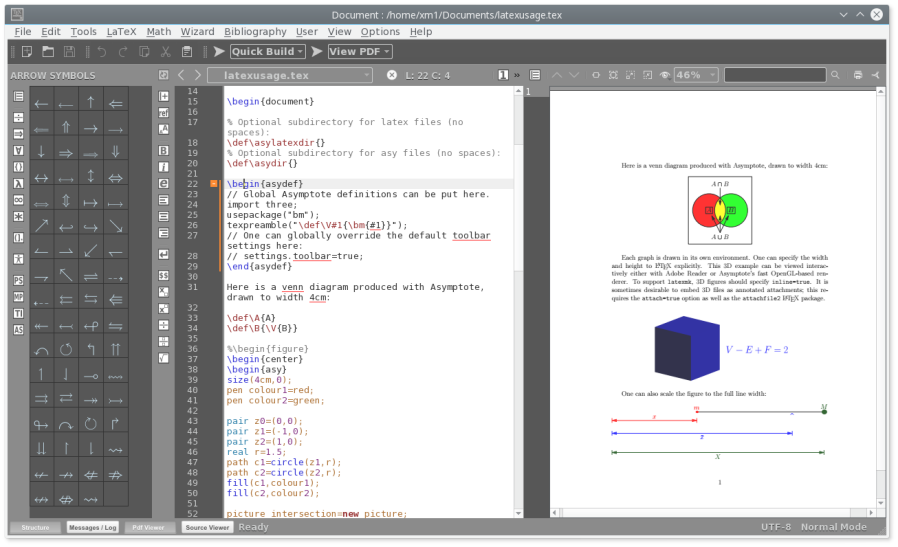
The USB-flash drive system contains a preinstalled an enormous amount of open source software. Libreoffice (Office replacement), GIMP (Photoshop replacement), a terminal emulator, Chromium webbrowser and a File explorer are a few examples. I included a FORTRAN compiler, which allows to run all my old programs, Texmaker (to work with Latex to write my book), YAD to generate a graphical interface and Anydesk to be able to take over PC’s of my customers all over the world. All this software is easily loaded from the Debian site but don’t forget to run first the “sudo apt update” command before installation.

Texmaker editor

As a service, BELGLAS sells this USB-flash drive with possibly all the FORTRAN programs, with and without source, I have written about cellular glass annealing, foaming, thermal shock, pipe thermal insulation, … . By nature, when your PC is booted with this USB-flash drive, all the programs will run for sure.

At last but not at least, I like to thank Klaus Knopper, who developped this valuable tool.

Klaus Knopper


WSL: Linux during Windows

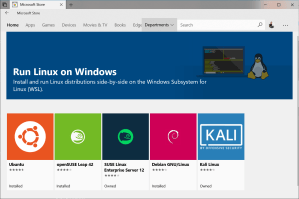
logo_smallIn a previous post in 2016, we already reported on this move of Windows. At that time, a real BASH – shell was available. In this application, only text based programs without GUI could be run. Today, we have WSL2 (Windows Subsystem for Linux), which works with a real Linux-kernel and allows to call GUI-programs from the command line.

storeWSL-Ubuntu can be run as in a terminal of  (as an example) MobaXterm. The X-server of MobaXterm (free for home-use) makes the GUI possible. We have succesfully installed and used

  • GNU FORTRAN
  • Mousepad and Gedit editors
  • GNUplot to show our data
  • LibreCad to make 2D drawings
  • Qpdfviewer to show pdf-files
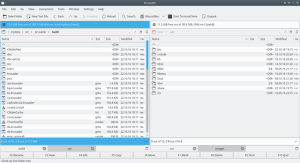
  • Krusader to search and navigate in the filesystem.
  • Zenity to write BASH scripts with GUI

krusader-twinpanel-thumbIt is possble to enter the Windows filesystem, which is mounted under /mnt and in this way, Linux and Windows-applications can be run on the same files. A C-complier and Python2 and python3 interpreters are already standard availbale with WSL-Ubuntu. The ordinary scientist has everything for his standard scientific work with this WSL-Ubuntu.

DownloadWe may speculate about Windows 11. Will it be totally based on LINUX and in that way make all other LINUX-distros unnecessary? I would not be surprised. In the mean time, I enjoy the feeling that a community of free of charge working programmers clearly influence the decision of a large multinational.


FORTRAN: An old but new language in memoriam of Prof. Dr. Olav Verbeke

logo_smallThe first time I met FORTRAN (and programming) was as a part of a numerical analyis course at the University in 1981. We had to “write” the program with punch cards. It was FORTRAN77 and we did not speak about structured programming at that time. During my PhD-time, I worked with FORTRAN 77 with my adviser Olav Verbeke. In that time, there were already rumours that in further versions, we should have to decalere all variables and we should forget the equivalence statement.  Later on, I learned C at one employer and then again I used FORTRAN77, with a lot of GOTO´s at another one. I moved from UNIX to LINUX, introduced there the GNU FORTRAN compiler and  used him to compile succesfully the old HP-FORTRAN77 programs.

fortran_bannerI made some new programs myselves and I found out that structured programming without GOTO, COMMON, … statements is very wel possible with FORTRAN90 for all our typical numerical programs. Structures of different types of variables can be described while subroutines can be collected in modules. C-functions can be merged in a FORTRAN program. Moreover, object oriented programming and parallel programming is also possible in FORTRAN 2003 and 2008, but I do not use that for the moment. Recently, also a GUI is available in order to make the program userfriendly with buttons and graphs. In case only a graph is needed, including GNUplot in the program is a fast and neat way to go.

imagesSome time ago, I was considering Python but the slowness of this interpreter is sometimes a problem. A direct competitor is C++, which is as fast as FORTRAN with splendid GUI possibilities but is complicated to learn. I decided to continue with my “old” FORTRAN and to wrap the subroutines in Python, if a GUI is needed. In fact, a lot of the Python modules in Numpy and Scipy are wrapped FORTRAN routines.

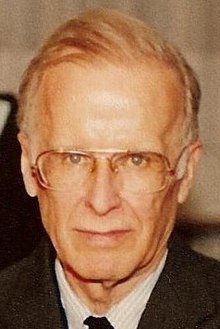
220px-John_Backus_2A lot of free FORTRAN source is available with the Numerical Recipes for FORTRAN 77 and FORTRAN 90, where the routines are well explained. Today, I program with CODE:BLOCKS IDE under Raspbian LINUX . I thank John Backus and his team for this wonderful job. John was the first one, who realized that developing a higher level language above assembler would speed up programming a lot. But he did not only have the idea, he also realized his idea at IBM. The name of his child was FORTRAN.


Raspberry Pi 4, a very nice “open source” surprise

logo_smallFor a long time, I am in favor of open source programs. My scientific work is done under Linux with GNU FORTRAN and some Python. Reports are written with Latex and spreadsheets are done with Libreoffice. Graphics are made with GNU-plot and my documentation system is Wikipedia. But I have to agree that I needed a lot of times an expensive LINUX consultant to get the thing running. And in some cases, the expert was not able to get it running because the relevant computer component has not a good driver for LINUX.

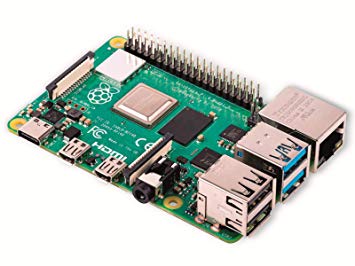
71RJj8SmQGL._SX355_The Raspberry Pi on the other hand is a cheap computer, developed to run with LINUX, in this case the Debian based Raspbian. Moreover, it is meant as a didactic tool for students. I bought a Raspberry Pi 4 with 4GB RAM, transformator, 32GB SD-card, which serves as hard disk, a small touch screen  and a HDMI cable for 100€ all-in. This is indeed cheap.

My colleague (a Windows expert) assembled the small computer and installed Raspbian on the SD-card in about 30 minutes and  it was already running. He also installed RDP (remote desktop) to have access from another PC or tablet or mobile phone when a second monitor, keyboard and mouse are not available.

I installed  without any knowledge GNU FORTRAN, a Python development environment, a keyboard on the small screen, LATEX with Texmaker, GNU-plot, SAMBA (to allow Windows explorer in the Raspberry Pi), Midnight Commander, Apache web server and WORDPRESS together with the MySQL database with the help of the well documented Raspbian site but without an expensive LINUX consultant. I program my Raspberry with a Windows laptop running MobaXterm.

And indeed, everything is working perfect, it is a nice surprise I never expected for 100€. I advise to install like me the small screen for (25€ ) because it allows to type a new Wifi code without monitor, keyboard and mouse. After making a copy of the SD-card, I can share my work on a new Raspberry Pi 4 without any installation.


How Greta Thunberg influences cellular glass production

logo_smallGreta Thunberg is the young Swedish girl, who kicked the ass of most adults towards a more ecologic world to avoid a climate catastrophe. The fossil addicted adults react quite aggressively like most addicted people, not becoming their drug anymore. Nevertheless, Sweden wants to gretabecome the first fossil free country, the latest in 2045. This move is already extended to Europe by Ursula von der Leyen for a CO2-neutral Europe in 2050.

downloadThis decision has large consequences for the production of cellular glass. Indeed, today about 95% of the foaming of glass is done with fossil energy, primarily natural gas. For the foaming, glass powder, mixed with a foaming agent, has to be heated to above 800°C.

For the foaming of gravel, SiC (dry process) or glycerin / water glass (wet process) are used and both foaming recipes can be done in air without protective air. For that reason, GLASOPOR in Norway changed from fossil to electric heating. As a consequence, their CO2-emission per m³ decreased from 35 kg to 7 kg, like shown in the old  and  new EPD. I guess they use renewable electricity  produced by water or wind.

The company STESS, producing Neoporm and already mentioned in a previous blog was also using a recipe, which was able to foam nicely in an electric furnace, like I have observed with my own eyes once in Wuppertal. It seems to be based on an organic foaming agent and water glass.

On the other hand, it is well known that foaming with carbon (black) (valid for 95% of the cellular glass boards) needs a protective atmosphere to avoid burning of the foaming agent before sintering of the glass. In case this process has to be done with electric heating, it will be necessary to generate a protective atmosphere with separate means. One way is the solution of  float glass, where Nitrogen, mixed with 5% Hydrogen is injected into the furnace above the tin bath through the roof to avoid oxidation of the tin. This solution is quite expensive while a tin bath can be much better closed against air than a foaming furnace.

It is clear that before 2050 the cellular glass world has to be converted to electric heating with alternative recipes or expensive equipment to avoid early oxidation of the foaming agent. Greta has really impact, I am proud on that girl and I will do my part of it.
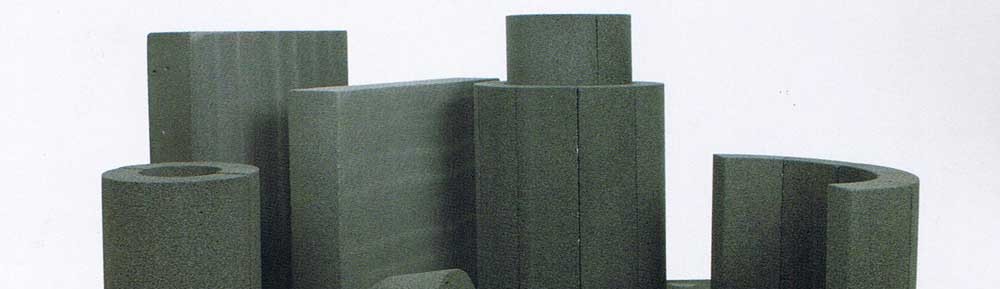
The first passive house with cellular glass walls

logo_smallA typical saying is that passive house walls with cellular glass are becoming too thick due to the moderate thermal conductivity. Like most sayings, the truth is something else, it is founded on conservatism. Indeed, Denmark has its first cellular glass passive house and the next one is underway.

The house is a Clean Tech Block result, which is already mentioned in previous blog. Clean Tech Block is a project from  Gråsten Teglværk, the University of Aalborg and the University of Ljubljana.

Havnevej 60 (u_stillads) 001.jpeg

newspaperThe project is described in a  newspaper, the “Der Nordschleswiger”.  It is real example of durable building and all the typical certificates are granted.

The choice for cellular glass is obvious:

  • air tight (passive house standard)
  • vapour tight and so no risk for humidity accumulation
  • free from rodents, ants and other animals.
  • long if not eternal lifetime
  • ecologic, according to the Swiss even the most ecologic thermal insulation
  • non-combustible
  • self-supporting, no deformation due to mechanical load or temperature
  • almost the same thermal expansions as the other minerals used in the building
  • not expensive if produced by direct foaming of recycled glass.

In our opinion, this is a major step in cellular glass building.

Ants like XPS and EPS but hate cellular glass

logo_smallPolystyrene is used in the thermal insualtion world in two versions: XPS (Extruded polystyrene) and EPS (expanded polystyrene). Both are used as thermal insulation in buildings besides cellular glass.

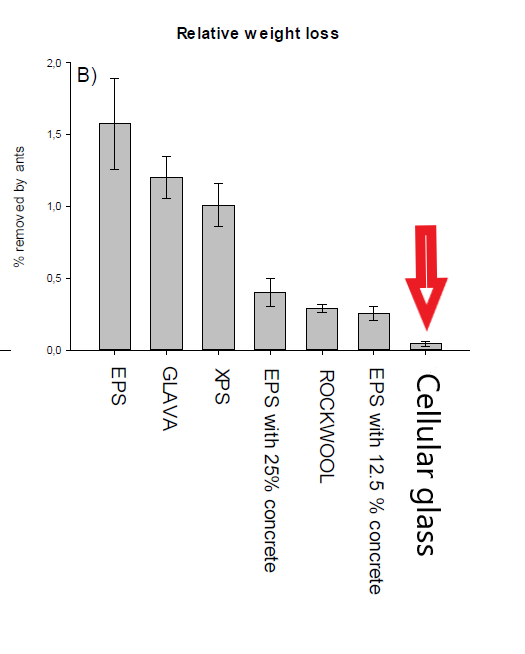
mierAnts are insects which lives in large groups and may destroy some building materials. It has been found in an extensive work of the Norwegian Institute of Public Health that ants are excaviating XPS and EPS in an important way, while leaving cellular glass in peace.

Hereunder, we give a comparison figure, extended with glass wool and mineral wool.

antcomparison

It is clear that cellular glass is not of interest for ants, which is a major advantage of cellular glass compared to the other thermal insulations. Some people should argue that a laboratory experiment is not the real case. The following XPS-boards, found on a jobsite in Germany  in real life says everything.

The damage to the building is clear but these ants do not absorb this polystyrene. It ends as plastic contamination in the soil and is dangerous for the human health. It is amazing that this material is still allowed.