During summer, Europe has a lot of excess heat production by power plants and other industries besides solar energy. This heat can be stored below 100°C in large water tanks or pits, like we already discussed in a previous post. Indeed, water has a large specific heat and does not contaminate soil.

In Meldorf, Germany, the first Pit Thermal Energy Storage (PTES) is build to heat public buildings in winter by Ramboli and Solmax. First a large pit is dug (100m x 100) like shown hereunder.
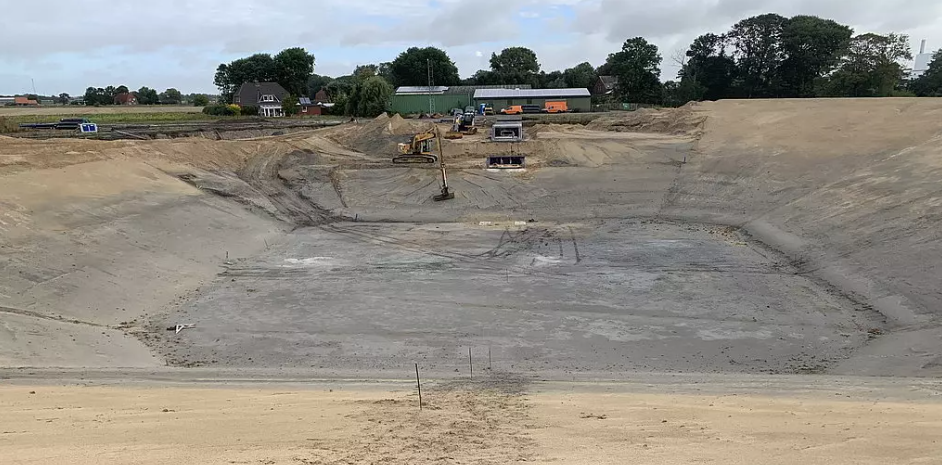
The sides and bottom of the pit are covered with HDPE-foil to make the pit watertight like hereunder.

The pit is filled with water and an 2.5mm HDPE-foil is covering and floating on the water. It is perfectly possible to walk on this HDPE-foil. On this foil, a layer of Glapor PG600 cellular glass is installed (800 x 600 mm boards) and later on a layer PIR and tapered EPS is installed. On top of the EPS, a rain-membrane is installed, where the tapered is installed in such a way that the rain water can be easily drained. Hereunder, the installation of the cellular glass and PIR on the HDPE-foil is shown.

More information will be given later about this historal step. In the past, the first layer was (hot) PE-foam, which is too much creeping at 80°C under the weight of a puddle water, which becomes larger and larger by the creeping. GLAPOR PG600 cellular glass does not creep measurable under even the load of 15m water load below 400°C.
 BELGLAS BV